For centuries, the bindi has been more than just a dot of color on the forehead. In India, it’s been tied to identity, spirituality, and social status. But here’s the question many young women ask today: Can an unmarried girl wear a bindi? The answer isn’t as simple as yes or no. It depends on where you are, who you’re asking, and what you’re trying to say.
What is a bindi, really?
The bindi comes from the Sanskrit word bindu, meaning ‘drop’ or ‘point’. Traditionally, it was applied between the eyebrows-the spot believed to be the seat of the sixth chakra, or the third eye. It was meant to focus energy, ward off negative forces, and symbolize inner wisdom. For married women, especially in North India, the red bindi became a visible sign of marital status. That’s where the confusion starts.
But here’s the thing: the red bindi wasn’t always only for married women. In many parts of India, especially in South India and rural communities, girls as young as five wore bindis-not as a marital symbol, but as decoration, protection, or part of daily ritual. In Tamil Nadu, it’s common to see young girls wearing black or green bindis made from kumkum or charcoal. In Maharashtra, children wear bindis during festivals like Gudi Padwa. In Gujarat, unmarried girls wear them during Navratri. The color and style changed based on age, region, and occasion-not just marital status.
The myth of the red bindi = marriage rule
The idea that only married women can wear a red bindi is a modern stereotype, not an ancient rule. It became popular during the 19th and early 20th centuries, partly due to colonial influence and later, Bollywood. Movies often showed the red bindi as the unmistakable mark of a wife. That image stuck. But if you look at temple carvings from 800 years ago, or old family albums from the 1940s, you’ll see unmarried women, girls, and even widows wearing red bindis.
In fact, in many South Indian households, the bindi is worn by girls from childhood. It’s not about marriage. It’s about culture. In Chennai, where I live, it’s normal to see schoolgirls with small red bindis on their foreheads. Their mothers put it on before they leave for school-not because they’re getting married, but because it’s part of their routine, like brushing teeth.
Why does it matter who wears it?
There’s a deeper issue here. When people say unmarried girls shouldn’t wear a bindi, they’re not really talking about the dot. They’re talking about control. About who gets to decide how women express themselves. About rules that were never written down but are still enforced.
Ask a 16-year-old girl in Delhi if she can wear a bindi to her school. She’ll say yes-unless her teacher tells her it’s ‘too traditional’ or ‘too religious’. Ask her in a conservative family in Uttar Pradesh, and she might be told, ‘Wait until you’re married.’ That’s not tradition. That’s social pressure dressed up as custom.
Real tradition is diverse. It changes. It adapts. In Kerala, young women wear bindis with jeans and kurtas. In Bengal, college students wear glitter bindis to parties. In Mumbai, a single woman might wear a bindi to a job interview to feel grounded. None of these women are married. None of them are breaking rules-they’re rewriting them.
Modern bindi, modern meaning
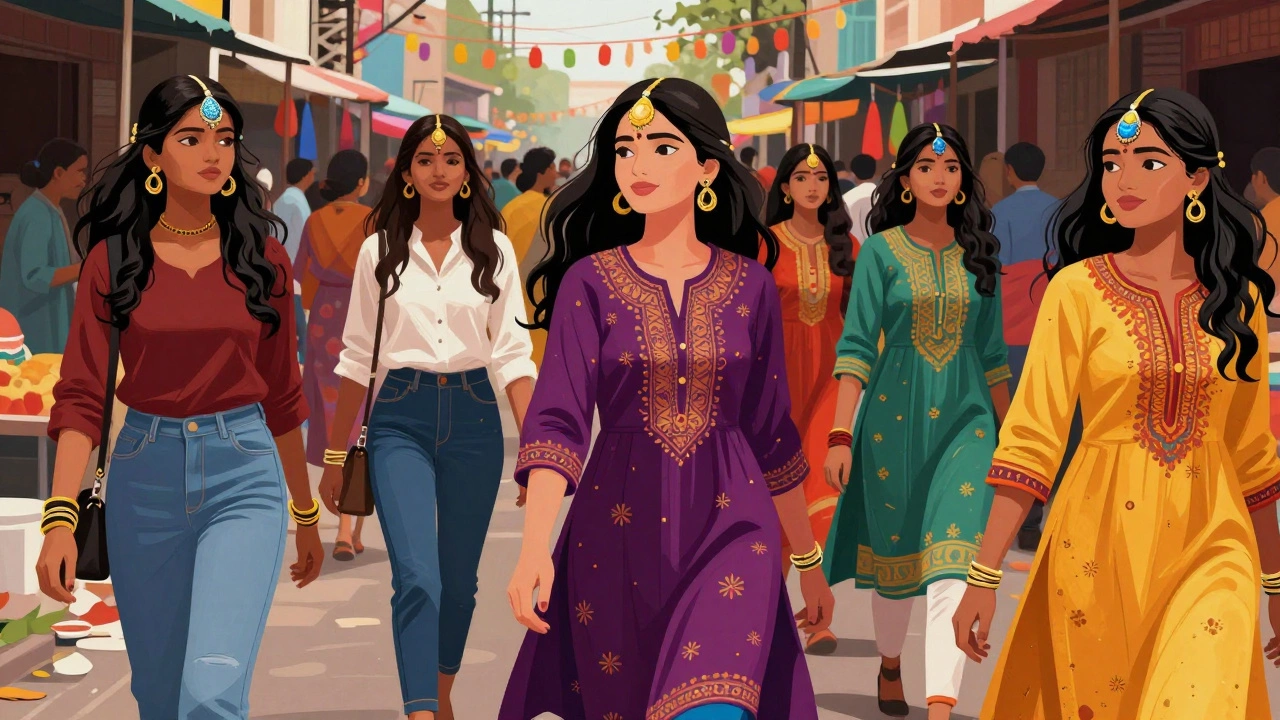
Today, the bindi is becoming a fashion statement, a spiritual anchor, or a political act. Young women are choosing bindis in every color: gold, blue, purple, even holographic. Some wear them for yoga. Others wear them to honor their grandmother. Some wear them because they like how they look.
In 2023, a study by the Indian Fashion Institute found that 68% of women aged 18-25 wear a bindi regularly, regardless of marital status. Over 70% of them said they wore it for personal expression, not cultural obligation. That’s a shift. A quiet revolution.
Brands like Anokhi, Good Earth, and even Zara now sell bindis as accessories. They come in packs. They’re stuck on with glue, not kumkum. They’re worn by models who aren’t married, by influencers who don’t follow rituals, by women who don’t care about tradition-but still feel connected to it.
What about religious spaces?
Some temples still have unspoken rules. In certain South Indian temples, unmarried women are asked not to wear red bindis during rituals. But that’s not a rule written in scripture. It’s a local custom, often based on outdated ideas about purity. In most major temples-Tirupati, Varanasi, Madurai-unmarried girls wear bindis without question. Priests don’t stop them. Devotees don’t stare. They just see someone praying.
And if you’re wearing a bindi to pray, does it matter if you’re married? The deity doesn’t ask for a marriage certificate.
What about the mangalsutra?
People often confuse the bindi with the mangalsutra. The mangalsutra is a necklace tied by the husband during the wedding. It’s a clear marker of marriage. The bindi? It’s not. You can wear both. You can wear one without the other. You can wear neither. There’s no rule that says you need one to have the other.
Many women in urban India wear a bindi and no mangalsutra. Others wear a mangalsutra and no bindi. Neither is wrong. Neither is incomplete. The symbols don’t work like puzzle pieces that must fit together.

So, can an unmarried girl wear a bindi?
Yes. Absolutely.
She can wear it in red. In black. In glitter. In gold. She can wear it every day. Only on Sundays. Only during festivals. Or never. It’s her choice.
The bindi is not a license. It’s not a badge. It’s not a rulebook. It’s a small mark on the forehead-with a long history, deep meaning, and endless possibilities. No one gets to tell a woman what her forehead can or cannot hold.
If someone says you can’t wear it because you’re not married, they’re not speaking for tradition. They’re speaking for their own comfort. And that’s not something you have to obey.
How to wear a bindi today
Here’s how to wear a bindi with confidence, whether you’re 12 or 32:
- Choose a color that feels right to you-not what someone else thinks you should wear.
- Wear it for yourself, not to prove something to others.
- Don’t feel guilty if you don’t wear one. Not wearing it is just as valid.
- If someone questions it, smile and say, ‘It’s mine.’
- Respect regional differences. In some places, black bindis are for girls. In others, red is for everyone.
- Pair it with whatever you’re wearing-saree, jeans, kurta, or a dress. It’s not a costume. It’s part of you.
When the bindi becomes a statement
Some women wear bindis to reclaim their identity. After the 2020 Delhi protests, many young women painted bindis on their foreheads during marches. It wasn’t about religion. It was about saying: ‘I am Indian. I am a woman. I am here.’
In 2024, a group of university students in Hyderabad started a campaign called ‘Bindi Is Not a Marriage Badge’. They handed out bindis on campus with stickers that said, ‘Worn by me, not by tradition.’ The campaign went viral. No one was arrested. No one was scolded. Just hundreds of girls wearing dots-on their own terms.
Tradition doesn’t die when it’s challenged. It grows.