Kada Wearing Guide Calculator
This calculator determines the traditional hand for wearing a kada based on your background and purpose. Results reflect cultural practices from North Indian traditions.
1. What is your religious background?
2. What is your marital status?
3. Why are you wearing the kada?
Select your options to see your result
When you see a woman in India wearing a thick, ornate metal bracelet - often gold or silver - it’s not just jewelry. It’s a kada, and where she wears it matters. Many people assume it’s just a style choice, but the truth is deeper. In traditional Indian culture, the hand you wear your kada on carries meaning, history, and even spiritual weight. So, does kada go on left or right? The answer isn’t simple, and it varies by region, religion, and family custom.
What Is a Kada, Really?
A kada is a solid, circular bracelet, usually made of gold, silver, or steel. Unlike delicate bangles that chime when you move, a kada is thick, heavy, and meant to be seen. It’s not just decoration. In Punjabi Sikh culture, the kada is one of the Five Ks - sacred articles of faith that baptized Sikhs wear at all times. For them, it’s a symbol of eternity and commitment to God. But even outside religious contexts, the kada holds deep cultural value across North India, especially in Punjab, Haryana, and Uttar Pradesh.
It’s common to see brides wearing a pair of kadas on both wrists during weddings. In some families, mothers pass down a kada to their daughters as a blessing. Men wear them too - often plain steel ones - as a sign of strength and protection. The material, design, and hand you choose all carry silent messages.
Left Hand or Right Hand? The Rules
There’s no single national rule for which hand a kada goes on. But there are strong regional and religious patterns.
In Sikh tradition, the kada is worn on the right hand. Why? Because the right hand is considered the dominant hand - the one used for eating, praying, and signing documents. Wearing it on the right reminds the wearer to act with integrity and stay connected to the divine in every action. For Sikh men and women, this isn’t optional. It’s part of their identity.
In Hindu families, especially in rural Punjab and Haryana, women often wear kadas on the left hand. The reasoning here is practical and symbolic. The left hand is traditionally seen as the receiving side - the hand that accepts blessings, gifts, and energy. Wearing a kada on the left is believed to help absorb positive vibrations and ward off negative energy. Some believe the left wrist is closer to the heart, making it a more emotional and spiritual choice.
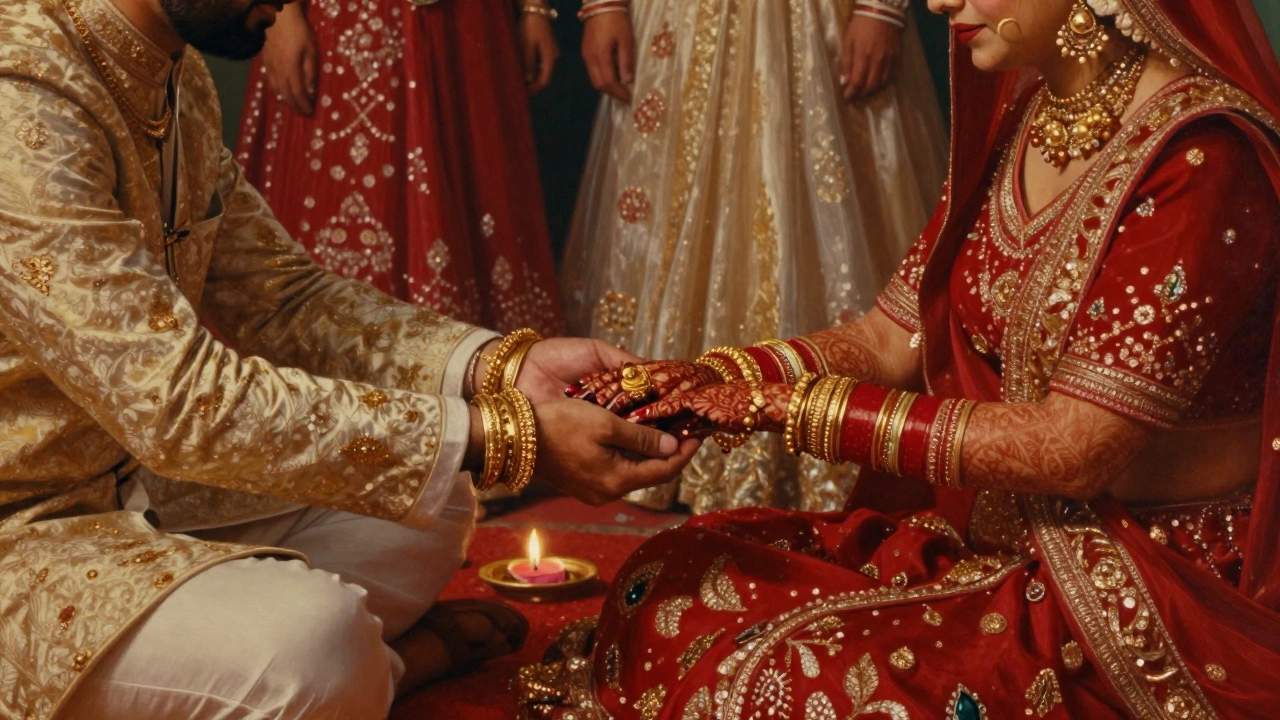
Married women in many parts of North India wear kadas on both wrists. It’s a sign of marital status, similar to the mangalsutra. But even then, the left often holds the heavier or more ornate piece. In some communities, the groom gives the bride her first kada during the wedding ceremony, and she wears it on her left wrist as a reminder of his promise.
Why Does It Matter?
Wearing a kada on the wrong hand isn’t a sin - but it can raise eyebrows. In tight-knit communities, jewelry choices are watched closely. A woman wearing a kada on her right hand might be seen as following Sikh customs, even if she’s Hindu. A man wearing a gold kada on his left might be questioned - is he trying to blend cultures? Is he honoring his wife’s family tradition?
There’s also a practical side. Most people are right-handed. Wearing a heavy kada on the right wrist can get in the way during daily tasks - cooking, cleaning, working. So even if tradition says right, comfort often wins. Many women today wear their kada on the left simply because it doesn’t snag on clothes or bump against pots and pans.
Modern Indian women are blending old rules with new life. A working professional in Delhi might wear a slim gold kada on her right wrist for style, while keeping a heavier steel one on her left for cultural reasons. It’s not about breaking tradition - it’s about adapting it.
Material Matters Too
The metal you choose tells its own story. Gold kadas are common for weddings and special occasions. Silver is worn daily in many households - it’s affordable and believed to have cooling properties. Steel kadas are most often linked to Sikh identity and are worn by men and women alike. Some families avoid iron or copper, believing they bring bad luck.
Engraved kadas with religious symbols - like the Ik Onkar or a lotus - are usually worn on the right, especially if they’re meant as spiritual tools. Plain, unadorned kadas are more flexible. They can go on either hand, depending on comfort or fashion.
What About Men?
Men wear kadas too - and the rules are simpler. In Sikhism, men wear it on the right, always. In other communities, men often wear it on the left, especially if it’s a family heirloom. Some men wear a single steel kada as a symbol of resilience. Others wear two - one on each wrist - during festivals or family ceremonies.
There’s no religious text that says men must wear it on one side only. But in practice, the right hand still dominates. Why? Because men are often expected to use their right hand for rituals, shaking hands, and giving offerings. Wearing the kada there keeps it visible as a reminder of duty and honor.
Modern Trends: Breaking the Rules
Today, younger Indians are redefining the kada. You’ll see it on the ankle as a anklet. You’ll see men wearing diamond-studded kadas on their left. You’ll see brides wearing mismatched kadas - one gold, one silver - on different wrists. Fashion designers in Mumbai and Bangalore are mixing kadas with watches, bracelets, and even rings.
But here’s what hasn’t changed: the emotional weight. Even when worn for style, the kada still carries legacy. A woman in London might wear a kada her grandmother gave her - on her right wrist, even though she’s never set foot in India. It’s not about following rules. It’s about holding on.

How to Choose Your Kada Hand
If you’re unsure where to wear your kada, start with this:
- If you’re Sikh - wear it on the right. Always.
- If you’re Hindu and married - consider the left for tradition, right for style.
- If you’re wearing it for protection or spiritual reasons - left hand is commonly preferred.
- If you’re wearing it as a gift from a family member - follow their custom.
- If you’re wearing it purely for fashion - wear it where it feels best.
There’s no penalty for choosing wrong. But understanding the why behind the choice makes the jewelry mean more.
Common Myths About Kadas
Let’s clear up a few misunderstandings:
- Myth: Only women wear kadas. Truth: Men wear them too - especially in Sikh and Punjabi communities.
- Myth: Kadas are only for weddings. Truth: Many wear them daily, especially steel ones.
- Myth: You must wear two. Truth: One is enough. Two is a choice, not a rule.
- Myth: Gold is the only proper material. Truth: Steel, silver, and even copper are used depending on belief and budget.
Final Thought: It’s Personal
There’s no universal answer to whether kada goes on left or right. The real answer is: it depends on who you are, where you come from, and what you want it to mean. For some, it’s faith. For others, it’s heritage. For many, it’s both.
Wear it where it feels right. Let it remind you of your roots, your strength, or the person who gave it to you. The hand doesn’t change the meaning - your intention does.
Can I wear a kada on both hands?
Yes, absolutely. Many married women in North India wear kadas on both wrists, especially during weddings or festivals. Some men do too, particularly during religious ceremonies. Wearing two doesn’t change the meaning - it just doubles the symbolism. It’s a personal choice, not a rule.
Is it okay to wear a kada if I’m not Indian?
Yes. Jewelry is a global language. Many non-Indian women wear kadas as fashion pieces or as a nod to spiritual practices. Just be respectful - understand the cultural roots, don’t treat it as a costume, and avoid using religious symbols like Ik Onkar unless you’re familiar with their meaning.
Can I wear a kada with a watch?
Yes, and many people do. If you wear a watch on your right wrist, wear the kada on your left, and vice versa. It’s common to mix traditional and modern accessories. Just make sure the kada isn’t too bulky - it could damage the watch strap or interfere with the mechanism.
Do kadas have to be circular?
Traditionally, yes. The circle represents eternity - no beginning, no end. That’s why most kadas are solid and unbroken. But modern designs sometimes break the circle for style. While these aren’t considered traditional, they’re still worn. Just know that if you’re following religious customs, a closed circle is preferred.
Can I wear a kada if I’m not married?
Of course. Kadas aren’t only for married women. Single women wear them for style, protection, or family tradition. In Sikhism, both single and married women wear the kada. In many families, girls receive their first kada as a child. Marriage has nothing to do with who can wear it.