Mangalsutra Knowledge Quiz
Test Your Knowledge
Key Insights
The mangalsutra is a sacred symbol in Hindu marriage, not just jewelry. Its meaning varies by region but always represents a lifelong commitment.
There’s no direct English word for mangalsutra. That’s not because English lacks vocabulary-it’s because the mangalsutra isn’t just jewelry. It’s a symbol woven into centuries of Hindu tradition, tied to marriage, identity, and spiritual commitment. Trying to translate it as "wedding necklace" or "marriage chain" misses the weight it carries in Indian homes. If you’ve ever seen a bride in a red lehenga with a black and gold pendant resting just above her heart, you’ve seen a mangalsutra. But what is it, really, beyond the metal and beads?
It’s Not Just a Necklace
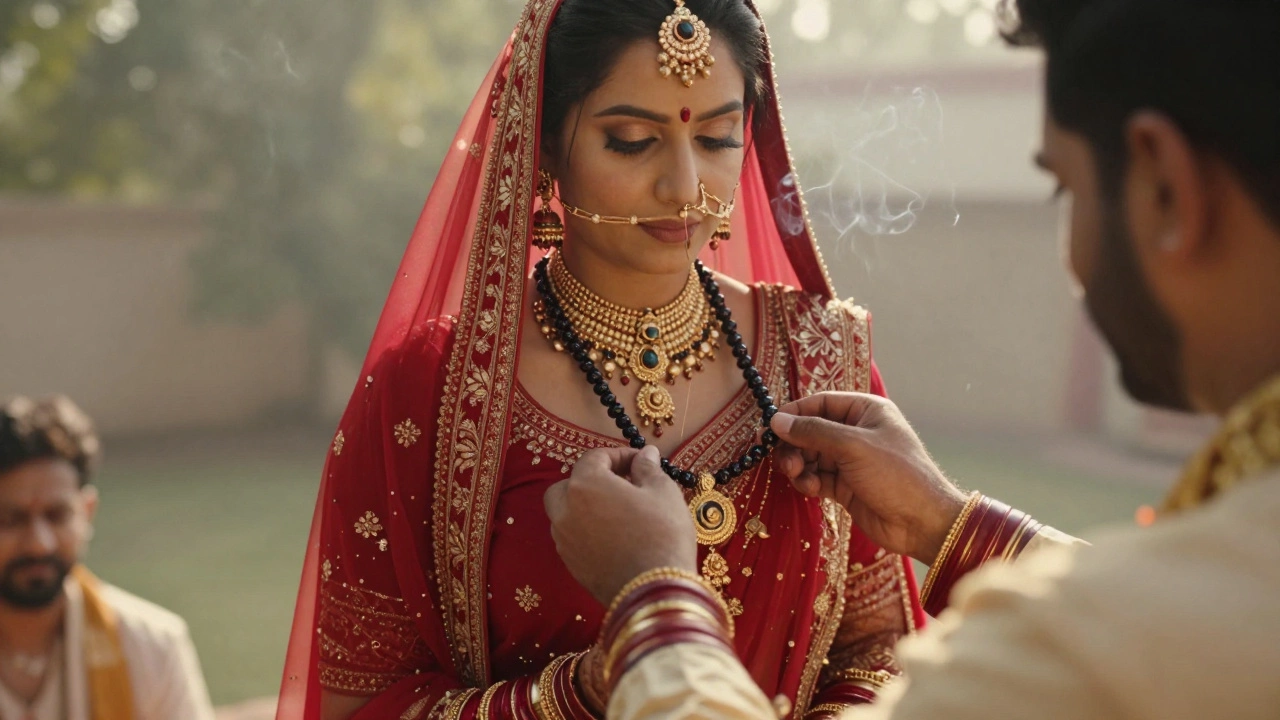
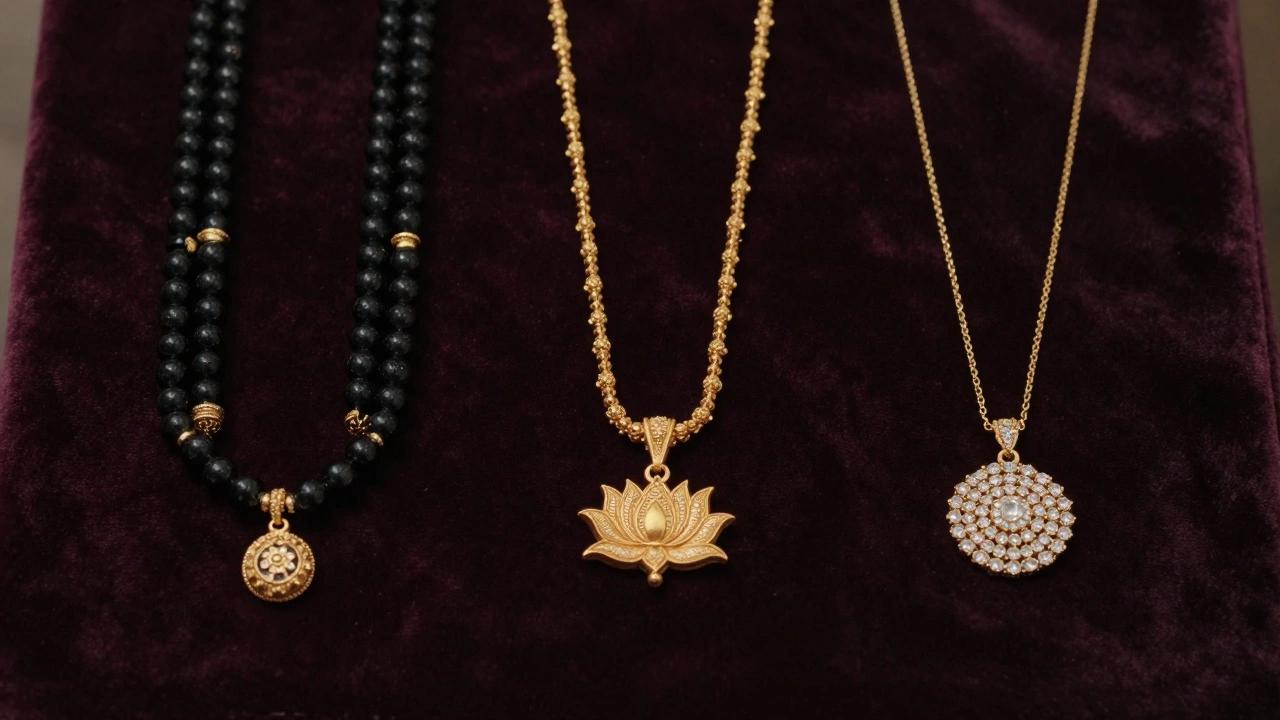
The mangalsutra is worn by married Hindu women across India, but its design varies wildly by region. In Maharashtra, it’s a black bead strand with two gold pendants. In South India, it’s often a gold chain with intricate temple-style pendants. In North India, you might see a diamond-studded pendant on a gold chain. The common thread? It’s tied by the groom during the wedding ceremony, usually with a mantra or prayer. That moment isn’t decorative-it’s sacred. Once tied, the mangalsutra becomes a living symbol of the marriage bond.
It’s not worn for fashion. It’s not worn to match an outfit. It’s worn as a declaration. In many families, removing it even for a moment is considered inauspicious. A widow may stop wearing it, not because she’s no longer beautiful, but because the ritual purpose has changed. This isn’t jewelry you buy at a mall. It’s inherited, passed down, or custom-made with care.
Why Doesn’t English Have a Word for It?
English has words for rings, bracelets, earrings-items that are personal adornments. But the mangalsutra doesn’t fit that category. It’s not an accessory. It’s a sacrament. Think of it like a wedding ring in Western cultures, but with deeper layers. A ring is a circle-no beginning, no end. A mangalsutra has beads, pendants, knots. Each part has meaning. The black beads are believed to ward off negative energy. The gold represents prosperity. The two pendants symbolize the union of two souls.
There’s no single English word that captures all that. "Wedding necklace" sounds like something you’d pick up at a tourist shop. "Marriage token" feels too clinical. "Sacred chain" gets closer, but still lacks cultural texture. Even "vows necklace" doesn’t work-it implies a promise you can take off. The mangalsutra isn’t taken off. It’s lived with.
What Do People Say in English When They Need to Explain It?
When speaking to non-Indian audiences, most people say: "It’s a traditional Indian wedding necklace worn by married women." That’s the safest, clearest way. Some add: "It’s similar to a wedding ring, but more symbolic and often more elaborate." That’s accurate enough for casual conversation.
In formal writing, like cultural studies or anthropology papers, you’ll see "mangalsutra" used without translation. That’s because it’s a proper noun in context-like "sari" or "bindi." You don’t translate those. You explain them. The same applies here.
Even in international jewelry catalogs, the term "mangalsutra" is kept intact. Brands like Tanishq, Kalyan Jewellers, and Joyalukkas list it under "Indian Bridal Jewelry" with the original name. Why? Because the name carries the meaning. Change it, and you lose the soul of the piece.
Designs Vary-But the Meaning Doesn’t
Let’s look at a few regional styles to see how form follows function:
- Marathi mangalsutra: Two gold pendants (called "vati") suspended on a black thread of 48 beads. The beads are made of black glass or onyx. The number 48 is traditional, tied to Vedic rituals.
- South Indian mangalsutra: Usually a gold chain with a lotus, temple, or coin-shaped pendant. Often paired with a gold nose ring and bangles.
- North Indian mangalsutra: A gold chain with a diamond or emerald pendant. Sometimes looks like a modern pendant necklace-but still worn daily, not just for events.
- Bengali mangalsutra: Known as "sankha" and "pola"-conch shell and red coral bangles, not a necklace. In Bengal, the mangalsutra concept is expressed differently.
Each design reflects local beliefs, materials, and aesthetics. But every version shares one thing: it’s worn by the wife as a sign of her marital status. In many villages, if a woman isn’t wearing her mangalsutra, people assume something is wrong. Is she separated? Widowed? Ill? The absence speaks louder than the presence.
Modern Changes, Same Core
Today, younger women in cities wear lighter, minimalist versions. Some skip the black beads entirely. Others wear a thin gold chain with a small pendant. That’s not a rejection of tradition-it’s adaptation. The core meaning hasn’t changed. It’s still a marker of marriage. It’s still worn daily. It’s still tied during the wedding ceremony.
What’s new is the choice. Women now pick designs that match their lifestyle. A software engineer in Bangalore might wear a delicate mangalsutra with her laptop. A doctor in Delhi might wear a gold one under her scrubs. The piece adapts. The meaning doesn’t.

Why Translation Fails
Translation isn’t just swapping words. It’s swapping worlds. The mangalsutra exists in a cultural ecosystem that includes rituals, gender roles, religious beliefs, and family expectations. In English, we have "wedding ring"-a single object with one meaning. In India, the mangalsutra is part of a whole system: the sindoor, the bangles, the toe rings, the red sari. These aren’t accessories. They’re markers of a woman’s new role.
Try translating "sindoor" as "red powder." You lose the ritual of the groom applying it. Try translating "bangles" as "wrist jewelry." You lose the sound, the symbolism of married status, the way they clink when a woman walks.
The mangalsutra is the same. No English word can carry the weight of a thousand weddings, the prayers whispered over it, the generations who’ve worn it. It’s not a necklace. It’s a promise.
What to Say When Asked
If someone asks, "What do you call mangalsutra in English?"-don’t search for a perfect word. Give them context:
- "It’s a traditional Indian necklace worn by married Hindu women."
- "It’s tied by the groom during the wedding ceremony."
- "It’s not just jewelry-it’s a symbol of marriage and protection."
- "The black beads are meant to keep bad energy away."
- "In many families, it’s worn every day, even at work."
That’s more helpful than any single word. Language isn’t about finding equivalents. It’s about sharing understanding.
Final Thought: The Word Is Already There
You don’t need to translate "mangalsutra." You just need to say it. Say it with respect. Say it with the same care you’d say "wedding ring." Because in the end, that’s what it is-a symbol of love, commitment, and belonging. And in every culture, some things are best left in their own language.
Is mangalsutra the same as a wedding ring?
No, not exactly. A wedding ring is a circular band symbolizing eternal love. The mangalsutra is a necklace with beads and pendants, tied during the wedding ceremony with specific rituals. It’s worn daily and carries spiritual, cultural, and social meanings beyond just marriage. While both represent marital status, the mangalsutra is tied to Hindu traditions and includes elements like black beads for protection.
Can unmarried women wear a mangalsutra?
Traditionally, no. The mangalsutra is tied by the groom during the wedding ritual and is meant only for married women. Wearing it before marriage is considered inappropriate in most communities. However, some modern women wear similar-looking necklaces as fashion pieces-these are not called mangalsutras and are often labeled as "Indian-inspired" or "bridal-style" jewelry to avoid cultural misrepresentation.
Why are the beads black?
Black beads are believed to ward off negative energy or the "evil eye." In Vedic traditions, black is not seen as unlucky-it’s protective. The beads are usually made of black glass, onyx, or sometimes rudraksha seeds. The number of beads (often 48) is chosen based on astrological and ritual guidelines. The contrast between black and gold also symbolizes the balance between strength and prosperity.
Do all Indian women wear a mangalsutra?
No. The mangalsutra is specific to Hindu traditions and is not worn by women of other religions in India, like Muslims, Christians, or Sikhs. Even among Hindus, practices vary by region. In Bengal, for example, married women wear conch shell and coral bangles instead. Urban, educated women may choose not to wear it daily, but still keep it for ceremonies. The choice is personal, but the cultural roots remain strong.
Can a mangalsutra be made of silver instead of gold?
Traditionally, gold is preferred because it symbolizes prosperity and purity. Silver is rarely used in formal mangalsutra designs. However, in some rural areas or among families with financial constraints, silver or even stainless steel versions exist. These are usually worn as practical alternatives, not replacements. In modern times, some designers create gold-plated or gold-tone pieces for daily wear-but the gold element is still central to the ritual identity of the piece.