Chettinad Gold Authenticity Checker
Answer these questions to determine if your gold jewelry is likely authentic Chettinad gold. Based on traditional craftsmanship from the Chettinad region of Tamil Nadu, authentic pieces have these specific characteristics.
Chettinad gold isn’t just jewelry. It’s a story carved in gold, passed down through generations of artisans in the quiet towns of Tamil Nadu. If you’ve seen a heavy, intricate necklace with tiny gods, peacocks, and floral vines hanging from a woman’s neck during a wedding in South India, you’ve seen Chettinad gold. It doesn’t shimmer like modern gold jewelry. It speaks. It carries the weight of centuries, the rhythm of temple rituals, and the pride of a community that turned metal into myth.
The Roots of Chettinad Gold
Chettinad gold comes from the Chettinad region - a cluster of 74 villages in Sivaganga and Karaikudi districts of Tamil Nadu. This area was home to the Nattukottai Chettiar community, merchant bankers who built vast fortunes trading across Southeast Asia in the 18th and 19th centuries. When they returned home, they didn’t just build palatial mansions with teak wood and marble. They commissioned jewelry - not for fashion, but for devotion.
These pieces were made to be worn during temple visits, festivals, and weddings. Every ornament had a purpose. A headpiece wasn’t just decoration - it was an offering. A waistband wasn’t just adornment - it was a symbol of purity. The gold used was often 22-karat, thick, and unpolished to keep the ancient texture alive. Unlike the sleek, machine-made pieces you see today, Chettinad gold was hammered by hand, shaped by eye, and finished with tools passed from father to son.
What Makes Chettinad Gold Different?
Chettinad gold stands out because it doesn’t follow trends. It follows tradition. Here’s what sets it apart:
- Temple motifs: Gods like Lord Shiva, Goddess Parvati, Lord Ganesha, and Hanuman appear in raised relief. Peacocks, lotuses, and temple gopurams are common.
- Heavy construction: These pieces are thick, solid, and dense. A typical Chettinad necklace can weigh over 150 grams - far heavier than today’s delicate chains.
- Handcrafted detailing: Every tiny eye of a peacock, every petal of a lotus, is shaped by a single burin. No machines. No molds. Just the artisan’s steady hand.
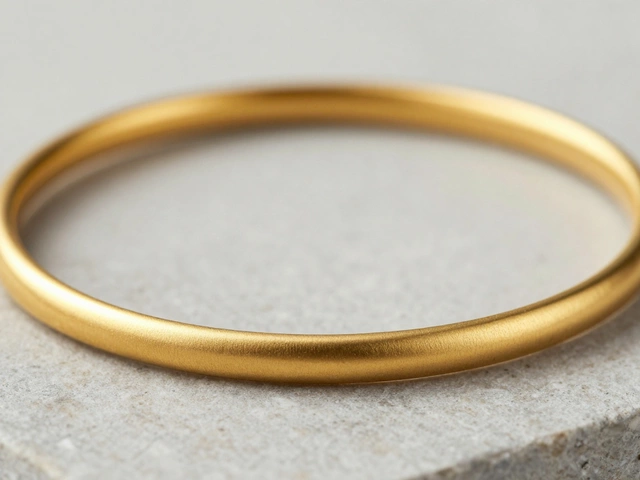
- Unpolished finish: Unlike modern jewelry that gleams, Chettinad gold has a matte, almost ancient look. This isn’t a flaw - it’s intentional. It reflects the sacred, not the showy.
- Functional design: Many pieces were designed to be worn in layers - necklaces with matching earrings, waistbands with armlets, and headpieces with hairpins. They worked as a set, like armor for the divine.
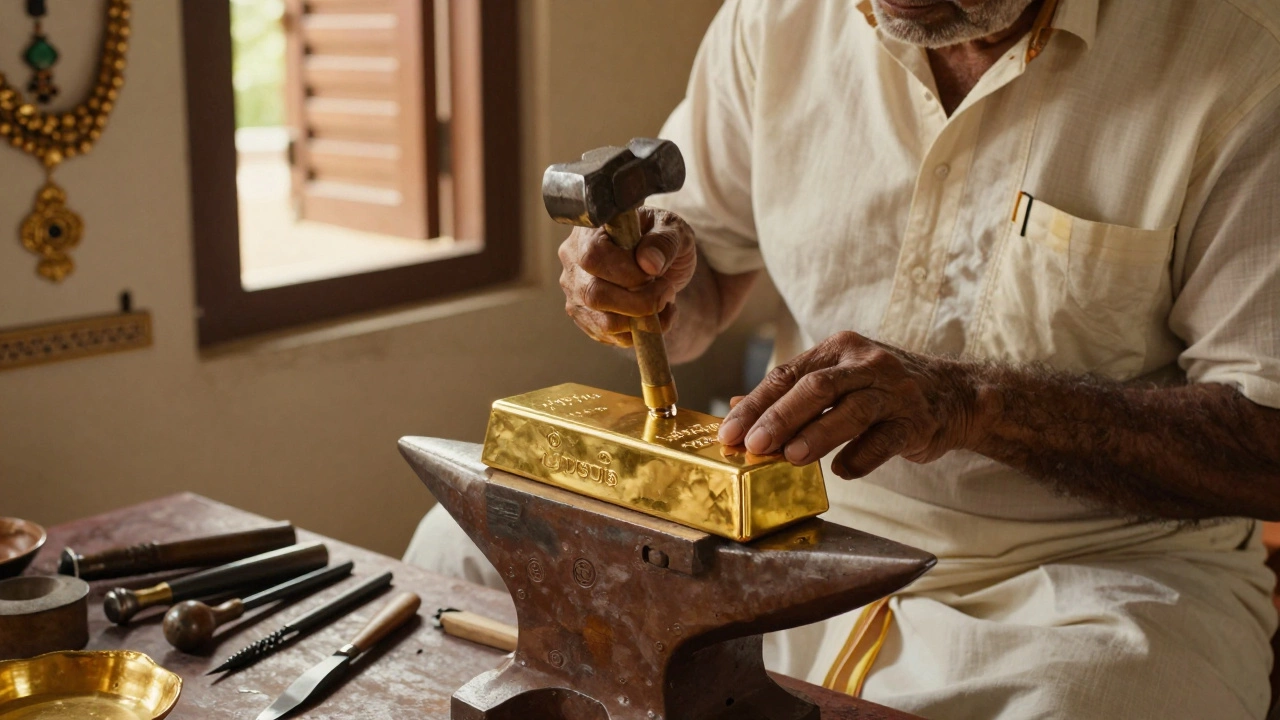
In the 1950s, when industrialization hit, most jewelers switched to lighter, cheaper designs. But in Chettinad, families kept the old ways alive. Even today, you’ll find artisans in Karaikudi using the same tools their great-grandfathers did. They still use the thotti (a small hammer), the thattu (a flat anvil), and the kal (a fine-pointed stylus) to create each piece.
The Craft: How It’s Made
Making Chettinad gold isn’t a job - it’s a ritual. The process takes weeks, sometimes months, for a single set.
- Gold selection: 22-karat gold is melted and cast into thick bars. No alloys. No plating. Pure gold, as it’s meant to be.
- Design sketching: The artisan draws the pattern on paper - often based on temple carvings or family heirlooms. No digital tools.
- Hand-hammering: The gold bar is shaped using a hammer and anvil. Each curve is struck by hand, creating the signature texture.
- Engraving: Using a burin, the artisan carves the motifs. A single peacock might take three days to complete.
- Setting stones: Tiny rubies, emeralds, or glass stones are set into the gold using the kanakam technique - a method where the stone is held in place by a tiny gold claw, not glue or prongs.
- Final polishing: Only the edges are lightly polished. The main surface stays matte to preserve the sacred look.
There are no factories here. A single artisan might make only 3-5 full sets in a year. That’s why original Chettinad gold is rare - and why prices start at ₹80,000 for a basic necklace and go up to ₹5 lakh or more for full bridal sets.

Where to Find Authentic Chettinad Gold
Most jewelry stores in Chennai, Coimbatore, or Bangalore sell pieces labeled as “Chettinad style.” But true Chettinad gold? You’ll find it in the old shops of Karaikudi, or through families who’ve been making it for five generations.
One trusted name is Palaniappa Jewellers in Karaikudi - established in 1942. Their pieces still carry the same hallmarks: thick gold, temple motifs, and that unmistakable matte finish. Another is S. M. Rajarathnam & Sons, who still use the same tools from the 1920s.
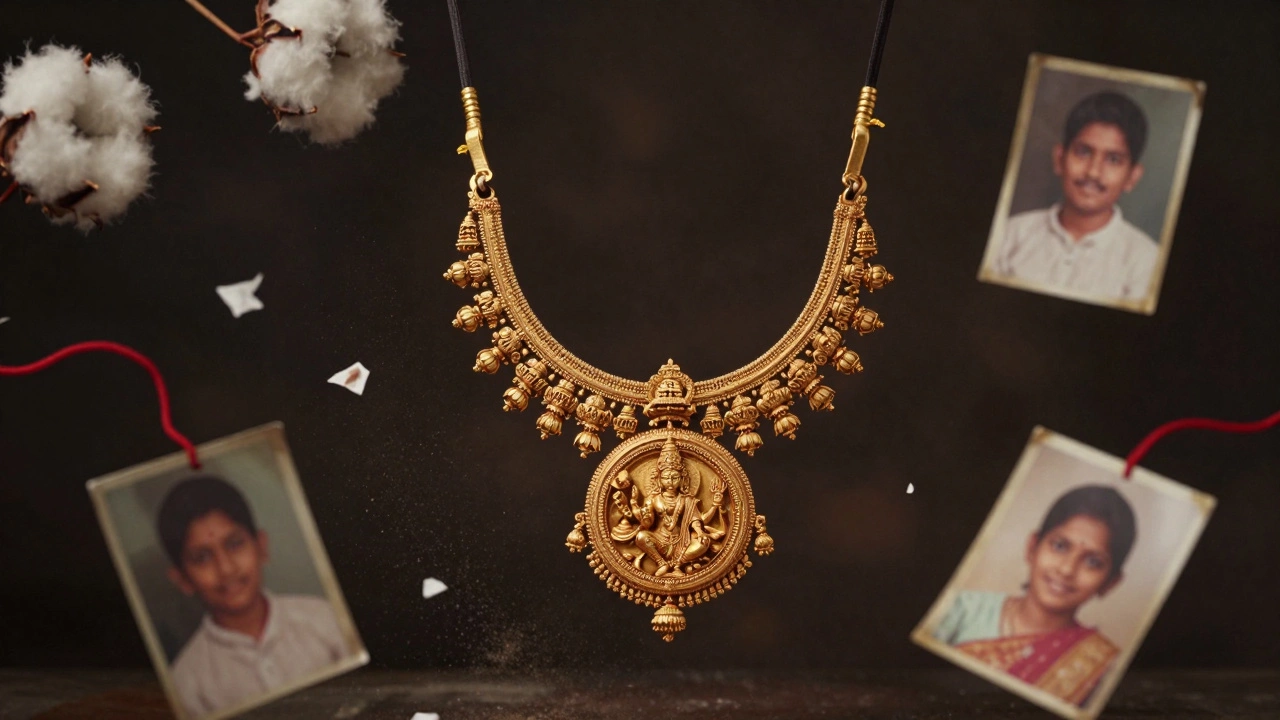
Online sellers claim to sell “Chettinad gold,” but if the piece is light, shiny, or has machine-cut details, it’s not real. Authentic Chettinad gold doesn’t come in a velvet box with a barcode. It comes wrapped in cotton cloth, tied with a red thread, and handed over with a story.
Why It Still Matters Today
Chettinad gold isn’t just a relic. It’s a resistance. In a world where jewelry is mass-produced, disposable, and designed for Instagram, Chettinad gold says: Some things are too sacred to be fast.
Young women in Tamil Nadu are beginning to wear these pieces again - not just for weddings, but for everyday temple visits. They’re choosing Chettinad gold over diamond studs because it connects them to their grandmothers, to their gods, to a time when beauty was measured in patience, not polish.
UNESCO recognized Chettinad’s traditional architecture in 2014. But the jewelry? Still waiting. No one has officially documented the craft as intangible heritage - even though it’s older than most Indian textile traditions. That’s why preserving it matters. Every piece made today keeps the skill alive. Every buyer who chooses authenticity over imitation helps keep the artisans working.
How to Care for Chettinad Gold
Because it’s unpolished and thick, Chettinad gold doesn’t need frequent cleaning. In fact, over-cleaning can wear away the details.
- Wipe gently with a dry, soft cotton cloth after wearing.
- Avoid chemicals - perfumes, lotions, and even sweat can dull the surface over time.
- Store in a cloth-lined box, separate from other jewelry. No plastic bags.
- Never use ultrasonic cleaners or harsh polishing agents.
- If it loses its sheen, take it to the original artisan. They’ll know how to restore it without damaging the carving.
Many families keep their Chettinad pieces for decades. Some are passed down as dowries. Others are donated to temples during festivals. A single necklace might have been worn by four generations of women - each adding their own story to the gold.
Chettinad Gold vs. Other Temple Jewelry
Temple jewelry exists across India - from Kerala’s Kundan pieces to Andhra’s Bobilli work. But Chettinad gold is different.
| Feature | Chettinad Gold | Kerala Kundan | Andhra Bobilli |
|---|---|---|---|
| Origin | Chettinad, Tamil Nadu | Kerala | Andhra Pradesh |
| Gold Purity | 22-karat, unpolished | 22-karat, polished | 22-karat, often with silver base |
| Primary Motifs | Gods, peacocks, temples | Flowers, birds, divine symbols | Floral vines, geometric patterns |
| Weight | Heavy (100-300g) | Medium (50-150g) | Light to medium (40-120g) |
| Setting Technique | Gold claws (kanakam) | Stone-in-gold (kundan) | Wire-wrapped stones |
| Finish | Matt | High polish | Matte to semi-polished |
Chettinad gold is the most sculptural. It doesn’t just sit on the body - it rises from it. The gods aren’t painted on. They’re born from the gold itself.
Is Chettinad Gold Worth the Price?
If you’re buying for investment, yes. Gold prices rise, and authentic pieces hold value better than any branded jewelry. But if you’re buying for emotional value - to wear something your great-grandmother wore, to feel connected to a tradition that refuses to fade - then the price isn’t money. It’s a promise.
Every Chettinad piece is a tiny temple. The gold is the altar. The stones are the offerings. And the artisan? He’s the priest.
Is Chettinad gold real gold?
Yes. Authentic Chettinad gold is made from 22-karat pure gold, with no plating or alloys. The gold is thick, heavy, and hand-hammered. Many pieces are stamped with the artisan’s mark or the family’s hallmark. If a piece is light, shiny, or labeled "gold-plated," it’s not real Chettinad gold.
Can I wear Chettinad gold every day?
Traditionally, these pieces were worn during festivals and temple visits. But today, many women wear lighter Chettinad pieces daily - especially earrings and small necklaces. Because the gold is thick and durable, it lasts decades. Just avoid wearing it during heavy physical work or while applying lotions or perfumes.
How do I know if a Chettinad piece is authentic?
Look for these signs: heavy weight, matte finish, hand-carved motifs (not machine-smooth), and temple-inspired designs like gods or peacocks. Check if the seller can name the artisan or workshop. Avoid pieces sold online with stock photos - real Chettinad gold is made to order and rarely mass-produced. Ask to see the hallmark or visit the workshop in Karaikudi if possible.
Why is Chettinad gold so expensive?
It’s expensive because it takes weeks to make one piece by hand. A single necklace can require 200+ hours of labor. The gold is pure, the stones are hand-set, and the artisans are few. There’s no automation. No outsourcing. Just one person, one tool, one lifetime of skill. That’s worth more than any retail markup.
Are there modern versions of Chettinad gold?
Yes - but they’re not the same. Some designers now make lighter, smaller versions for everyday wear, using Chettinad motifs but thinner gold and polished finishes. These are beautiful, but they’re modern interpretations. True Chettinad gold keeps the original weight, texture, and sacred form. If you want the real thing, look for the old-school artisans in Karaikudi.