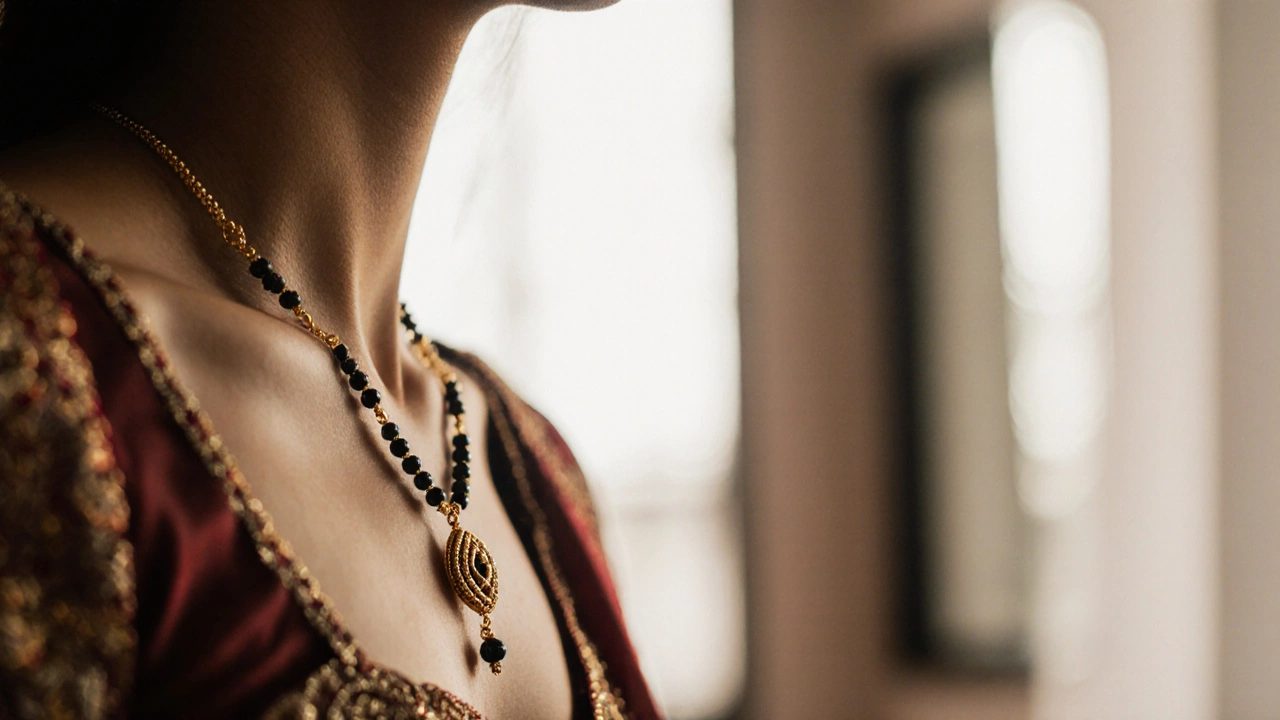
Look closely at a traditional mangalsutra, and you’ll see it-not just as a necklace, but as a chain with three distinct knots tied close to the pendant. These aren’t decorative afterthoughts. They’re intentional. They carry weight. And if you’ve ever wondered why there are exactly three, you’re not alone. Many wearers don’t know the story behind them. Others assume it’s just tradition without meaning. But the truth is deeper than that.
What the Three Knots Represent
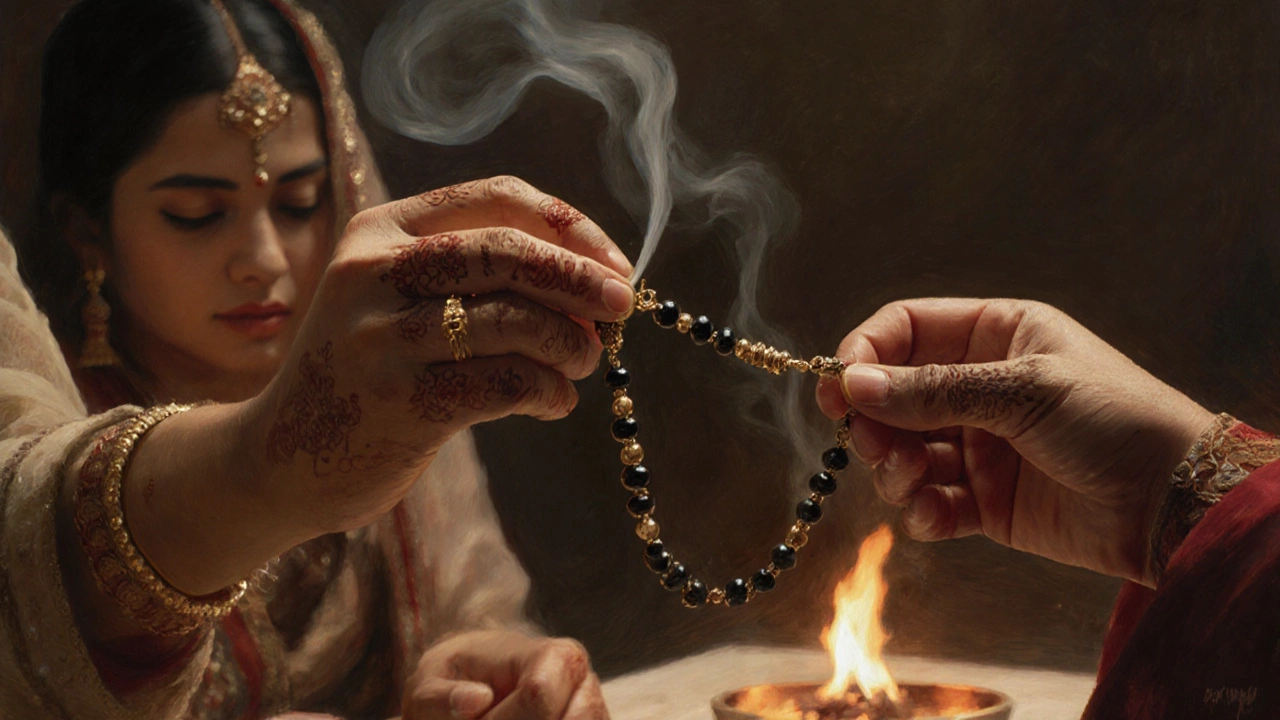
Each knot in the mangalsutra stands for a promise. Not just to the husband, but to the marriage itself. The first knot ties the wife’s commitment to her partner’s well-being. It’s a silent vow: I will care for you, protect you, stand by you. The second knot binds her to his family-not as an outsider, but as a daughter, sister, and anchor. It says: I embrace your roots, your values, your history. The third knot is the most personal. It’s the promise to herself-to stay true to her strength, her spirit, her identity within the union. This isn’t about submission. It’s about balance.
These knots aren’t just symbolic. They’re functional. In many regions, the knots are tied during the wedding ceremony by the groom’s sister or mother. The act is quiet, deliberate. No words are spoken, but the gesture carries generations of meaning. The knots are tied with black beads, often made of glass or stone, threaded between gold or platinum pendants. The black beads are meant to ward off negative energy. The knots? They’re meant to hold the relationship together.
Why Three? Not Two, Not Four
Why not two knots? Or four? The number three has deep roots in Indian philosophy. In Ayurveda, the body is governed by three doshas: Vata, Pitta, and Kapha. In Hinduism, the divine trinity-Brahma, Vishnu, and Shiva-represents creation, preservation, and transformation. Marriage, in this context, isn’t just a union of two people. It’s the merging of three forces: the individual, the partner, and the shared life they build.
Three also reflects the stages of a marital journey. The first knot is the beginning-the spark, the promise. The second is the endurance-the daily grind, the challenges, the compromises. The third is the evolution-the quiet understanding that grows over years, the unspoken trust that doesn’t need to be spoken aloud. It’s not about perfection. It’s about persistence.
Some communities tie the knots during the Saptapadi, the seven steps taken around the sacred fire. Each step is a vow. The three knots on the mangalsutra echo those vows in physical form. They’re a wearable reminder of what was said-and what was meant.
Regional Variations and Modern Takes
Not all mangalsutras have three knots. In Maharashtra, the traditional ‘Vati’ mangalsutra often features two or even four knots, depending on family custom. In Tamil Nadu, the ‘Thaali’ may have no knots at all, just a pendant suspended from a black thread. In Karnataka, the knots are sometimes replaced with small gold beads shaped like tiny bells. These variations aren’t mistakes. They’re dialects of the same language.
Today, modern designers are reimagining the mangalsutra. Some remove the knots entirely, replacing them with minimalist chains or engraved pendants. Others keep the knots but make them invisible-tiny, flush with the chain, barely noticeable. But when you ask women who wear these modern versions why they chose them, many still say, “I wanted the meaning, just not the look.” The symbolism remains, even when the form changes.
One woman in Bengaluru told me she wears a mangalsutra with three knots, but each one is made of recycled gold from her grandmother’s bangles. “It’s not just about marriage,” she said. “It’s about carrying her strength with me.” That’s the real power of the knots-they’re not static symbols. They grow with the wearer.
Myths and Misunderstandings
There’s a common myth that the three knots represent the husband, wife, and their future children. That’s not accurate. Children are a blessing, not a requirement of the marriage bond. The knots are about the couple’s dynamic-not what they produce, but how they hold each other.
Another myth: the knots are tied so the wife can’t remove the mangalsutra. That’s false. The mangalsutra is not a lock. It’s a reminder. Women remove it for bathing, swimming, or medical procedures without any cultural penalty. The real bond isn’t in the chain-it’s in the daily choices made between two people.
Some modern critics call the mangalsutra outdated. They say it’s a relic of patriarchy. But ask a young woman in Hyderabad or Delhi who wears a sleek, contemporary mangalsutra with three knots, and she’ll tell you something different: “It’s mine. I chose it. It’s not about being owned. It’s about owning my choice.”
How to Respect the Tradition Today
If you’re wearing a mangalsutra, whether by birth, marriage, or personal choice, the knots carry weight. You don’t need to follow every ritual. But understanding them changes how you wear it. Don’t treat it like a fashion accessory you put on and forget. Notice it. Feel it. Remember why it’s there.
If you’re buying one for someone else, ask: What does this mean to them? Don’t assume. Don’t impose. A woman in Mumbai recently chose a mangalsutra with three knots made of rose gold and embedded with tiny diamonds. “I wanted something that looked like me,” she said. “But still carried the truth.” That’s the key. Tradition isn’t about copying. It’s about continuing.
The three knots aren’t just threads tied in gold. They’re echoes of ancient wisdom, wrapped in a design that’s lasted centuries. They remind us that love isn’t just about passion. It’s about patience. About showing up. About holding on-not because you have to, but because you choose to, every day.
Why are black beads used in mangalsutra?
Black beads in a mangalsutra are traditionally believed to protect the wearer from negative energy or the "evil eye." They’re not decorative-they’re symbolic shields. Made from glass or stone, these beads are woven into the chain alongside the knots to reinforce the protective nature of the jewelry. This practice comes from ancient Vedic beliefs where dark colors were thought to absorb harmful vibrations. Today, many still wear them for cultural continuity, even if they don’t believe in the superstition.
Can a woman wear a mangalsutra after her husband passes away?
Yes, many women continue to wear their mangalsutra after the death of their husband, especially in urban and modern communities. In some regions, widows remove it as a sign of mourning, but in others, keeping it on is seen as a sign of enduring love and respect. There’s no single rule-it depends on family tradition, personal belief, and regional customs. Many women today choose to wear it quietly, as a personal tribute rather than a social signal.
Do all Indian brides wear a mangalsutra?
No. While the mangalsutra is common in North and West India, many communities in South India, East India, and among Christian or modern Hindu families don’t use it. In Tamil Nadu, the Thaali is the equivalent. In Bengal, it’s the Sankha and Pola. In some communities, a ring or bangle serves the same purpose. The mangalsutra is not a universal Indian wedding item-it’s one of many traditions, shaped by region, caste, and personal choice.
Is the mangalsutra only for married women?
Traditionally, yes. The mangalsutra is tied during the wedding ceremony and is worn as a marker of marital status. But today, many unmarried women wear it as a fashion piece or cultural symbol. Designers now make versions without knots or with modern materials. While purists may object, there’s no rule saying you can’t wear it. What matters is intention. If you wear it to honor heritage, not to deceive, it’s still meaningful.
Can men wear a mangalsutra?
No, not traditionally. The mangalsutra is a distinctly feminine symbol tied to the wedding ritual for women. Men wear different symbols of marriage, like a ring or a thread around the wrist in some communities. While gender norms are shifting, the mangalsutra remains culturally tied to women. Some couples now wear matching jewelry, but the mangalsutra itself-especially with the three knots-is still reserved for women in most traditions.