Turquoise Authenticity Checker
Check Your Turquoise Authenticity
Use this tool to determine if your turquoise jewelry is likely real or fake based on the criteria described in the article.
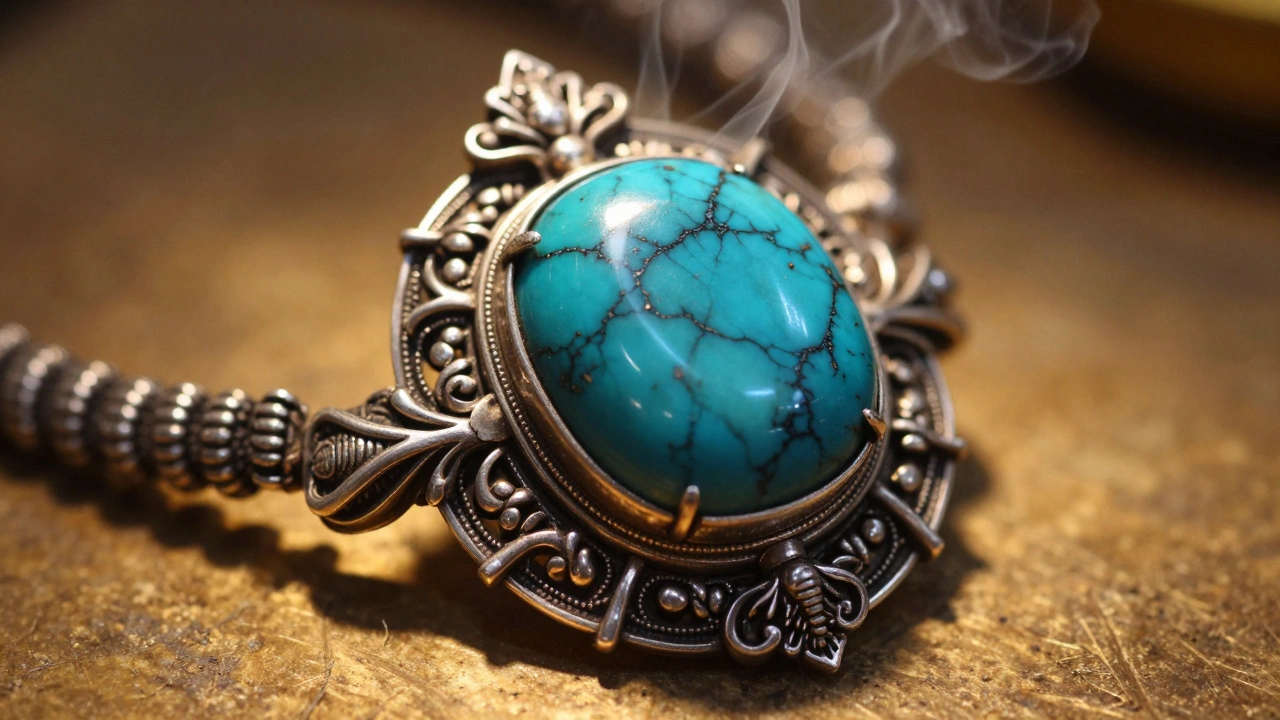
Walk into any temple jewelry shop in Chennai, Varanasi, or even a quiet lane in Mumbai’s Zaveri Bazaar, and you’ll see pieces with deep blue-green stones set in intricate silver filigree. These aren’t just decorations-they’re sacred. And if you’ve ever checked the price tag, you’ve probably paused. Why does a small turquoise stone cost more than a gram of silver? The answer isn’t just about rarity. It’s about history, belief, and the quiet collapse of a centuries-old supply chain.
It’s Not Just a Stone-It’s a Sacred Symbol
In South Indian temple jewelry, turquoise isn’t chosen for its sparkle like a diamond. It’s chosen because it’s believed to carry divine protection. In Tamil Nadu and Andhra Pradesh, temple dancers wear turquoise in their hairpins and forehead ornaments, thinking it wards off the evil eye. In Kerala, it’s stitched into the borders of ritual garments worn during temple festivals. This isn’t decoration-it’s spiritual armor.Unlike diamonds, which are valued for brilliance, turquoise is valued for its color and what it represents. A deep, even blue-green, almost like the sky before rain, is considered the most powerful. If the stone has fine black or brown veins-called matrix-it’s even more prized. That’s because, in traditional belief, the matrix is the stone’s soul. A clean, uniform turquoise? It’s pretty. A stone with natural, irregular veins? It’s sacred.
The Supply Has Vanished
Fifty years ago, most turquoise used in Indian temple jewelry came from Iran. The mines near Nishapur produced stones so rich in color, they were called ‘Persian turquoise.’ Indian artisans preferred them because the stone was dense, stable, and took polish beautifully. But in the 1980s, political instability, mining restrictions, and environmental crackdowns in Iran made exports nearly impossible.Today, the few Iranian stones that make it to India are smuggled or sold through middlemen in Dubai. Each stone is tracked, taxed, and marked up. A single 8mm cabochon that cost $15 in 1990 now sells for $80-$120 in Mumbai’s wholesale markets. And that’s before it’s set into a piece of jewelry.
Some jewelers tried switching to American turquoise from Nevada or Arizona. But those stones are softer, chalkier, and fade in sunlight. They crack when heated during the traditional silver-setting process. Others turned to Chinese turquoise, but it’s often dyed or stabilized with resin. Artisans who’ve worked with both say: “You can tell the difference in a glance. The real one breathes. The fake one just sits there.”
Handmade Craftsmanship Adds the Real Cost
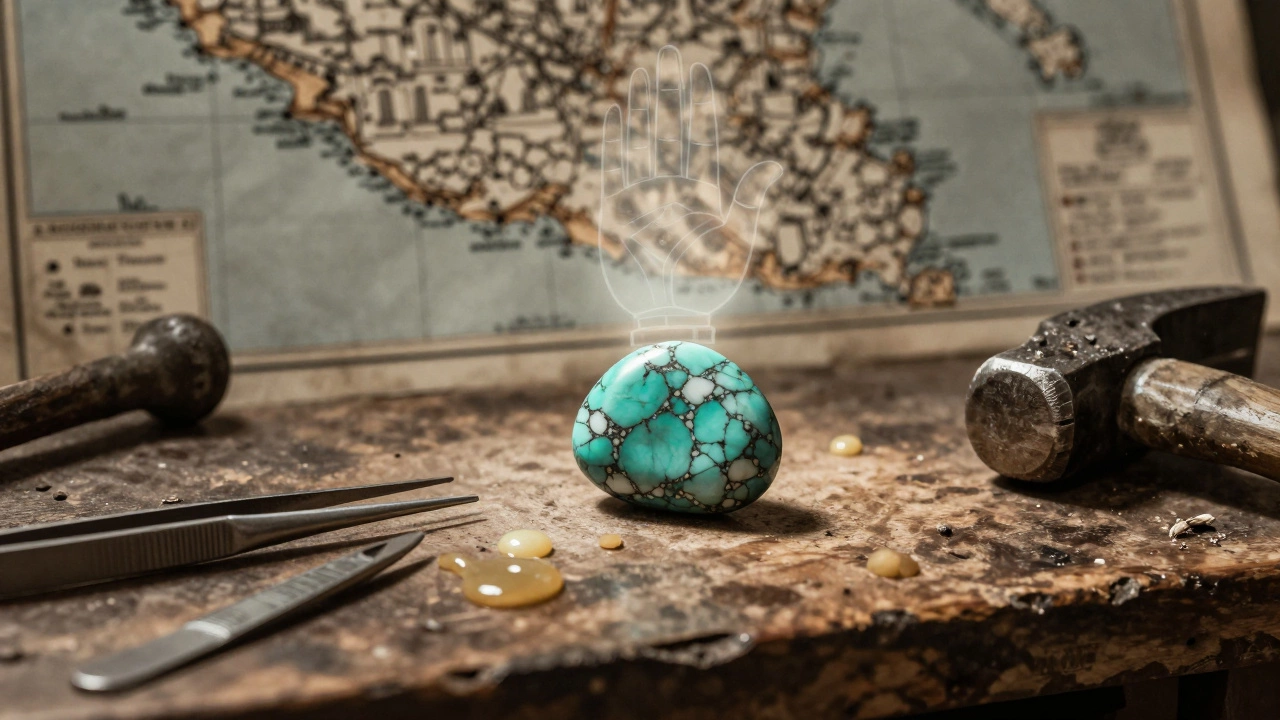
A turquoise stone doesn’t just get glued into a silver setting. It’s embedded by hand, using a technique called ‘kundan’-style inlay, where molten wax is used to hold the stone in place before the silver is poured around it. This requires years of training. In villages near Kancheepuram, master craftsmen start apprenticeships at age 12. They learn to hold the stone with tweezers no bigger than a mosquito’s wing, without cracking it.One artisan I met in Madurai told me he sets only three turquoise stones a day. Three. Not because he’s slow, but because one wrong move and the stone shatters. That’s $100 gone in a second. So the labor cost isn’t an add-on-it’s baked into every piece.
And the silver? It’s not sterling. It’s 95% pure, hand-forged, and hammered thin to make the filigree delicate enough to look like lace. Machine-made silver from China looks shiny but feels cheap. Temple jewelry must feel heavy. It must whisper tradition when it moves.

There’s No Substitute That Works
You might think: why not use lapis lazuli? Or how about dyed howlite? Or even synthetic spinel?Because none of them carry the same weight-literally or spiritually.
Lapis is too dark. Howlite fades in sweat. Synthetic stones don’t have matrix. And matrix? That’s the key. In temple rituals, the veins in turquoise are seen as the path of divine energy. A flawless stone? It’s empty. A stone with natural veins? It’s alive.
Some modern jewelers now use ‘reconstituted turquoise’-powdered stone mixed with resin. It’s cheaper. It looks okay from a distance. But temple priests refuse to bless pieces made with it. Why? Because the stone must be natural. The blessing, they say, only works if the stone was formed by the earth, not a factory.
What You’re Really Paying For
When you buy a turquoise temple pendant for ₹18,000, you’re not paying for a gemstone. You’re paying for:- A stone dug from a mine in Iran, smuggled across borders, and tested by experts in Mumbai
- Three days of work by a craftsman who’s spent 20 years learning to handle it
- 95% pure silver, hammered by hand, shaped with tools passed down for generations
- A belief system that’s survived invasions, colonialism, and modernization
- The guarantee that this piece will be worn in a temple ceremony, passed to a daughter, and still hold meaning 50 years from now
There’s no other jewelry in India where the cost is so tied to something invisible-faith, history, and the silence between a master’s hands and a stone’s soul.
How to Spot Real Turquoise in Temple Jewelry
If you’re looking to buy, here’s what to check:- Color: Look for uneven tones-deep blue fading into green. Uniform color? Likely dyed.
- Matrix: The black or brown veins should look natural, like tree roots. If they’re too perfect, it’s painted on.
- Weight: Real turquoise is dense. Hold it. If it feels light, it’s fake or resin-filled.
- Heat test: Gently warm the silver near the stone with a hairdryer (don’t touch the stone). Real turquoise won’t change. Resin will soften or smell like plastic.
- Ask for origin: Reputable sellers will say where the stone came from. If they say ‘imported’ without details, be cautious.
And if a piece is priced under ₹5,000 and has turquoise? It’s not real. Not because it’s fake-it’s because the cost of the real thing doesn’t allow it.
Why This Matters Beyond Price
Turquoise in temple jewelry isn’t just a commodity. It’s a thread connecting us to a world that’s fading. Young artisans are leaving the craft. Mines are closed. Buyers want cheaper, faster, Instagram-friendly pieces.But when you wear a turquoise piece from a temple jeweler, you’re not just wearing jewelry. You’re holding a piece of a living tradition-one that still believes stones can protect, stones can speak, and stones can carry prayers across centuries.
That’s why it’s expensive.
And that’s why it’s worth it.