Diamond Face Shape & Nose Pin Finder
Enter your facial measurements in centimeters or inches to determine your face shape and get personalized nose pin recommendations.
Face Shape: --
--
Nose Pin Recommendation
Avoid: --
Styling Tip
--
Enter your measurements and click "Analyze" to see your results.
You’ve probably heard that oval faces are the "ideal" canvas for any accessory. But if you’re hunting for something truly unique, you might be wondering: what is the rarest face shape? It’s a question that pops up in beauty forums and jewelry chats alike. The answer isn’t just about vanity; it’s about understanding how light hits your features and why certain nose pins look stunning on some people but awkward on others.
The consensus among dermatologists and stylists points to one specific geometry: the diamond face shape. It’s elusive, striking, and often misunderstood. If you have high cheekbones and a narrow forehead or jawline, you might belong to this exclusive club. But knowing you have a diamond face doesn’t automatically tell you which jewelry to buy. In fact, most generic advice fails here because standard rules assume an oval baseline. Let’s break down what makes this shape so rare, how to spot it, and exactly how to pick nose pins that celebrate its sharp angles rather than fighting them.
Why Diamond Faces Are Considered Rare
When we talk about rarity in face shapes, we aren’t using hard census data like blood types. Instead, we rely on anthropological studies and aesthetic surveys. Most population samples show that oval and round faces dominate globally. Square and heart shapes appear less frequently but still hold steady percentages. Then there’s the diamond. Estimates suggest that only about 2% of the population naturally possesses this structure. That’s roughly two out of every hundred people you pass on the street in Melbourne.
So, what defines a diamond face? It’s all about width distribution. Your cheekbones are the widest part of your face-wider than both your forehead and your jawline. This creates a geometric diamond shape when viewed from the front. Unlike a heart-shaped face, which has a wide forehead tapering to a point, the diamond starts narrow at the top, expands dramatically at the cheeks, and then tapers again at the chin. It’s a structural anomaly that gives you an angular, almost chiseled appearance.
This rarity stems from genetics. Bone structure dictates face shape more than fat distribution does. While weight changes can soften edges, they rarely alter the fundamental width ratios of your skull. If you were born with prominent zygomatic bones (cheekbones) and a narrower cranial width above and below, you’re likely a diamond. This genetic lottery means you don’t need contouring tricks to create definition-you already have it. The challenge isn’t creating angles; it’s balancing them.
Spotting the Signs: Is Your Face Actually Diamond?
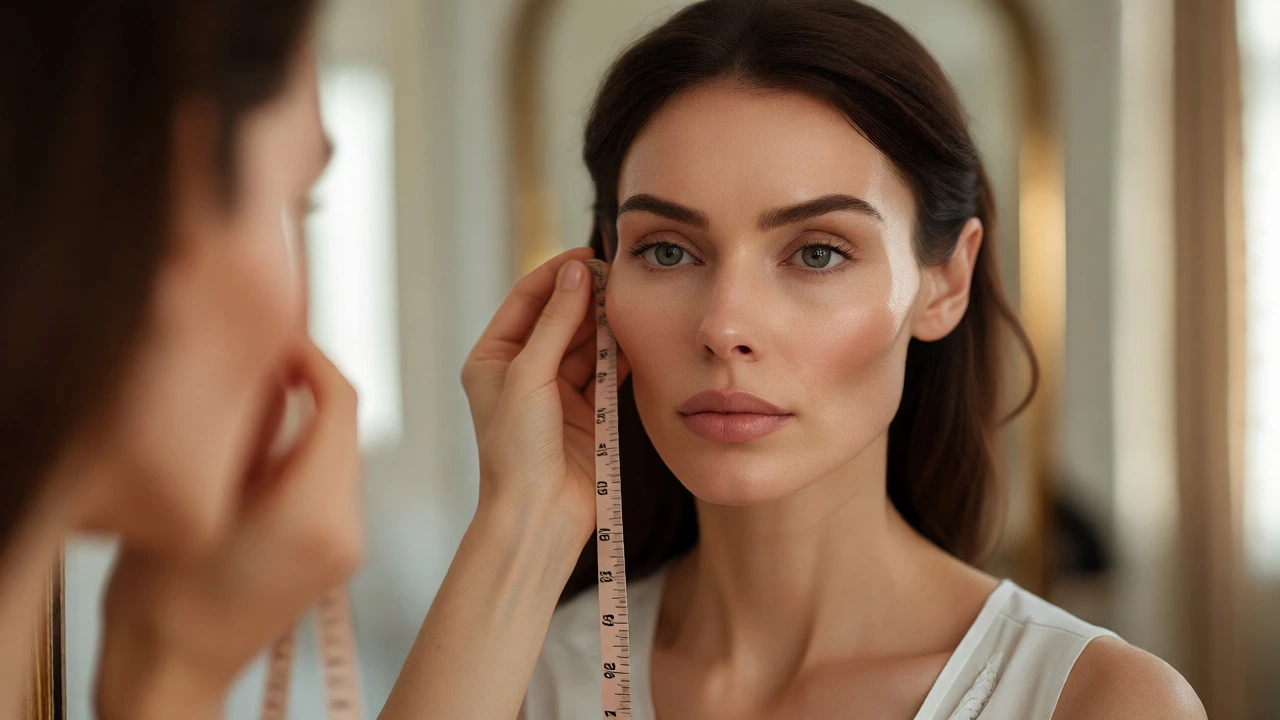
Misidentification happens constantly. Many people mistake their square faces for diamonds or confuse long oblong shapes with diamond structures. To confirm your status, you need to measure three key areas: forehead width, cheekbone width, and jawline width. Grab a soft measuring tape or a piece of string and a ruler. Stand in front of a mirror with your hair pulled back completely.
- Forehead: Measure across the widest part of your forehead, usually just above the eyebrows.
- Cheekbones: Measure from the outer edge of one cheekbone to the other, right under the eyes.
- Jawline: Measure from the tip of your chin to the corner of your jaw, then double it.
If your cheekbone measurement is significantly larger than both your forehead and jawline measurements, you have a diamond face. If your forehead and jawline are similar in width but wider than your cheeks, you’re likely heart-shaped. If all three measurements are roughly equal, you’re square. The gap between cheekbone width and the other two metrics is the smoking gun. For true diamond faces, this difference is often noticeable even without a ruler-it’s the reason your glasses might slip or why hats feel tight on the temples but loose on the crown.
The Impact on Jewelry Selection
Here is where the conversation shifts from biology to style. Why does being in the 2% matter for buying a nose pin design? Because accessories frame the face. On an oval face, almost anything works because the proportions are balanced. On a diamond face, the eye is immediately drawn to the center-the nose and the cheeks. If you choose the wrong jewelry, you amplify the width of the cheeks while leaving the narrow forehead and chin looking exposed.
Think of your face as a canvas with a focal point. The goal is harmony. You want to draw attention to your eyes and lips while softening the extreme angles of the mid-face. Heavy, bulky jewelry placed near the ears can make the cheekbones look even broader by contrast. Conversely, delicate pieces might get lost against strong bone structure. The sweet spot lies in verticality and subtle sparkle.
| Face Shape | Width Distribution | Rarity Estimate | Jewelry Goal |
|---|---|---|---|
| Diamond | Cheeks > Forehead & Jaw | ~2% | Narrow the mid-face, add volume to top/bottom |
| Oval | Balanced proportions | ~30-40% | Maintain balance, any style works |
| Heart | Forehead > Cheeks > Jaw | ~10-15% | Add width to jaw, minimize forehead |
| Square | Equal widths, sharp jaw | ~10-15% | Softens angles, elongate face |
Choosing the Perfect Nose Pin for Diamond Faces
Since the nose sits centrally, it acts as the anchor for your entire facial symmetry. For diamond faces, the nose is often straight and well-proportioned, which is great news. However, the surrounding high cheekbones can cast shadows or draw focus away from the nose itself. You want a nose pin that complements the sharpness without competing with it.
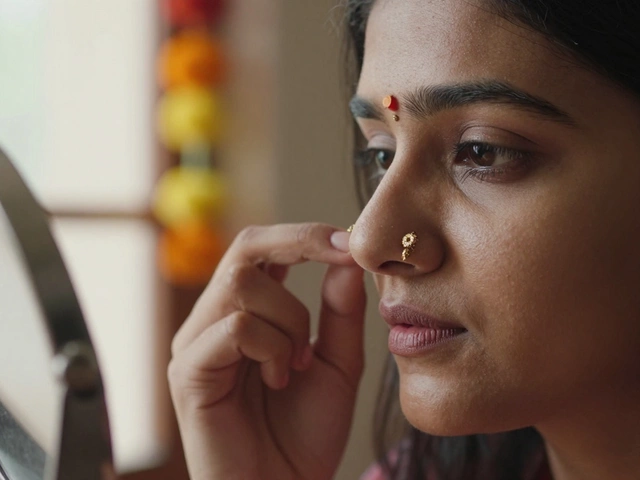
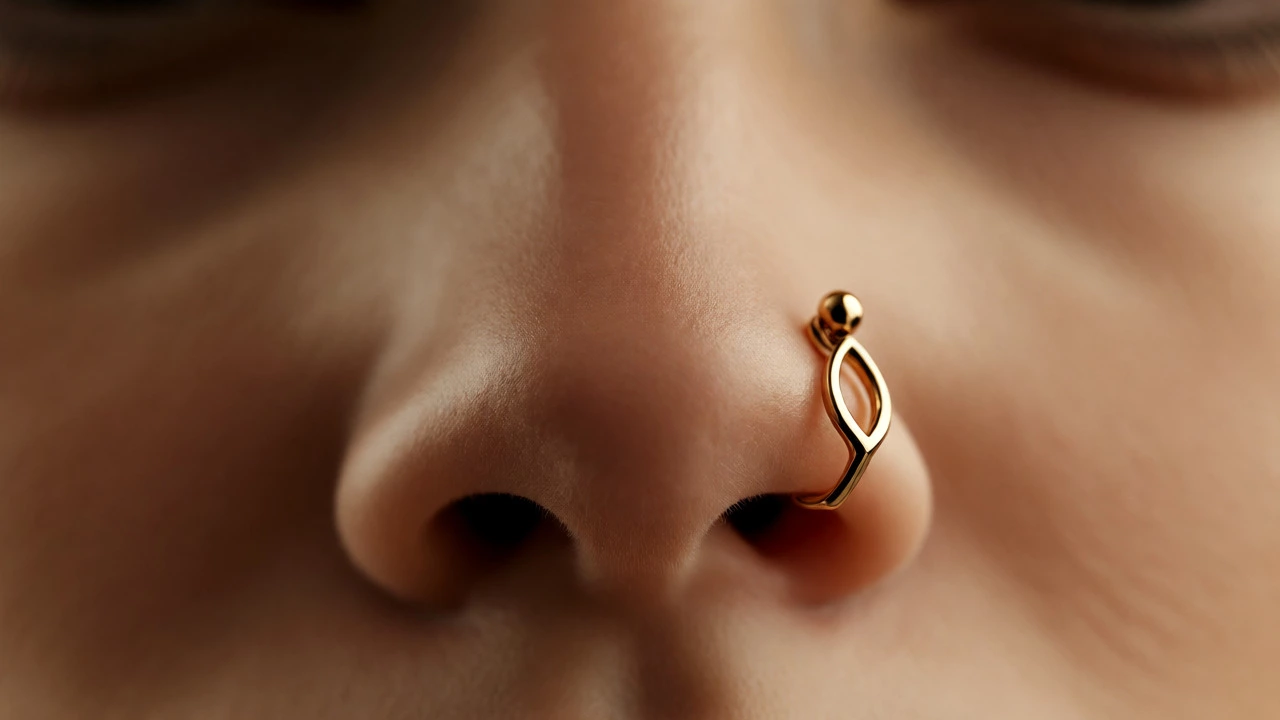
Avoid oversized hoops or heavy stud clusters. These add horizontal bulk to the center of the face, making the cheekbones appear wider by comparison. Instead, opt for designs that introduce vertical lines or subtle asymmetry. A small drop pendant attached to a stud can lengthen the visual line of the nose, counteracting the horizontal emphasis of the cheekbones. If you prefer studs, go for geometric shapes like triangles or teardrops. These echo the natural angles of your face rather than clashing with them.
Consider the placement too. Standard nostril piercing is fine, but a slightly higher placement can sometimes balance the lower half of the face better. If you have a septum piercing, keep it minimal. Large septum rings can shorten the appearance of the upper lip area, throwing off the delicate ratio between the nose and chin. Small, intricate gold or silver work shines best here. The metal color matters less than the scale. A tiny diamond solitaire catches the light differently than a large pearl, and on a diamond face, precision beats size every time.

Styling Tips Beyond the Nose
Your nose pin doesn’t exist in a vacuum. It interacts with earrings, necklaces, and even makeup. Since you have a rare face shape, you have a distinct advantage: you can pull off bold looks that overwhelm softer faces. But you must manage the flow of attention.
Earrings should not sit directly parallel to the cheekbones. If you wear hoop earrings, ensure they hang low enough to clear the widest part of your face. Long, dangling earrings are excellent for diamond faces because they draw the eye downward, balancing the wide mid-section. Avoid button-style earrings that sit right on the earlobe; they tend to emphasize the cheekbone width.
Makeup plays a role too. Contouring is optional for you since your bone structure is already defined. Focus instead on highlighting the center of your face. Brighten the bridge of your nose and the inner corners of your eyes. This brings focus to the middle, where your nose pin lives, and distracts from the lateral width of the cheeks. When choosing colors, remember that cool tones often complement the sharpness of diamond faces, but warm gold jewelry can add necessary softness.
Common Myths About Face Shapes
People obsess over these categories, leading to plenty of misinformation. One common myth is that face shape determines attractiveness universally. Reality check: cultural standards vary wildly. What’s considered ideal in Western media might differ from trends in South Asia or East Asia. Another myth is that you can change your face shape through exercise alone. Facial exercises might tone muscles, but they won’t move bone. If you think you’re transforming a square jaw into a diamond shape via yoga, you’re setting yourself up for disappointment.
Also, stop worrying about fitting into a box. Many people have hybrid shapes. You might have diamond-like cheekbones but a slightly wider forehead, leaning toward heart. Or perhaps your jaw is sharper than typical, blending diamond and square traits. That’s normal. Use the diamond guidelines as a starting point, not a rigid rulebook. Adjust based on what actually looks good on you in the mirror, not what a chart says.
Is the diamond face shape really the rarest?
While exact global statistics are hard to pin down, most aesthetic and anthropological sources agree that the diamond face shape is the least common, appearing in approximately 2% of the population. Oval and round shapes are far more prevalent.
How do I know if I have a diamond face shape?
Measure your forehead, cheekbones, and jawline. If your cheekbones are noticeably wider than both your forehead and jawline, and your face tapers toward both the top and bottom, you likely have a diamond shape.
What nose pins suit diamond faces best?
Choose vertical or geometric designs like teardrop studs or small drop pendants. Avoid large, bulky hoops or wide horizontal studs that can accentuate the width of your cheekbones.
Can weight gain change my face shape from diamond to round?
Weight gain can soften the angles and fill out the cheeks, potentially making a diamond face appear more oval or round. However, the underlying bone structure remains, so the fundamental width ratios usually persist underneath the tissue.
Do celebrities with diamond faces influence jewelry trends?
Yes. Celebrities like Rihanna and Megan Fox often display diamond characteristics. Their choices in minimalist, angular jewelry often set trends because they demonstrate how to balance high cheekbones effectively.