Temple Jewelry Authenticity Checker
How to Verify Authentic Temple Jewelry
Based on the article, genuine temple jewelry has specific characteristics. Answer the questions below to check your piece's authenticity.
Authenticity Result
When you think of Indian jewelry, images of heavy gold necklaces, intricate bangles, and sparkling nose rings often come to mind. But if you want to know what India is truly known for - the kind of jewelry that carries centuries of ritual, artistry, and spiritual meaning - you’re looking at temple jewelry.
What Exactly Is Temple Jewelry?
Temple jewelry isn’t just jewelry worn during festivals. It’s a sacred art form born in the temples of South India, especially in Tamil Nadu, Andhra Pradesh, and Karnataka. Artisans called karigars crafted these pieces for deities, dressing idols with gold, precious stones, and enamel work. Over time, these divine adornments became symbols of status, devotion, and cultural identity for women in royal families and temple communities.
Unlike modern fashion jewelry, temple jewelry was never meant to be temporary. Each piece was designed to last generations. The metalwork alone can take weeks. A single necklace might use over 300 tiny gold filigree pieces, each hand-soldered. The designs aren’t random - they’re pulled from temple carvings: gods and goddesses, peacocks, lotus flowers, and conch shells.
The Signature Styles of Temple Jewelry
There are three main styles you’ll find across South India, each with its own distinct look and origin.
- Chettinad Jewelry - From the merchant communities of Tamil Nadu, this style uses bold gold plaques with deep engraving. Think wide necklaces with geometric patterns and large, dangling earrings shaped like temple gopurams (towers).
- Kovai Jewelry - From Coimbatore, this style is lighter, with more intricate filigree. The earrings often resemble miniature temple bells, and the hairpins are shaped like jasmine flowers.
- Madurai Jewelry - The most ornate of the three. Madurai pieces are known for their detailed repoussé work - metal hammered from the back to create raised designs. You’ll see entire scenes of deities on chest pieces, and earrings with tiny, moving bells inside.
These styles aren’t just regional preferences - they reflect the temple architecture and local deities. A piece from the Meenakshi Temple in Madurai will have different motifs than one from the Tirupati temple. The jewelry tells a story before it even touches skin.
Materials and Craftsmanship
Temple jewelry is almost always made from 22-karat gold. Silver is rarely used - gold is sacred in Hindu tradition, believed to attract divine energy. Stones aren’t just decorative; they’re symbolic. Rubies stand for power, emeralds for prosperity, and pearls for purity. Many pieces still use uncut stones, called kundan, set in gold without metal backing.
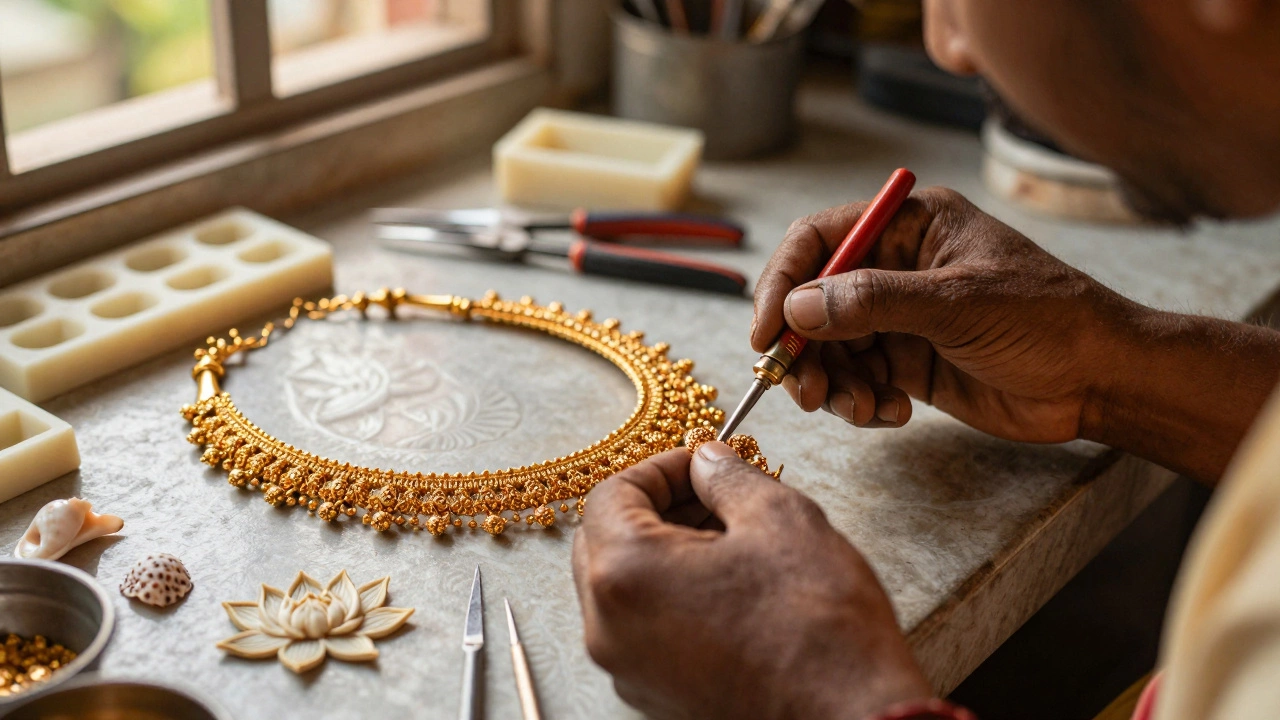
The craftsmanship is unlike anything you’ll find in mass-produced jewelry. Artisans use tools unchanged for 500 years: small chisels, fine-tipped pliers, and wax molds. A single pair of temple earrings can take 40 hours to complete. The filigree - thin gold threads twisted into lace-like patterns - is so delicate that a single breath can misplace a strand. That’s why these pieces are passed down, not bought.

Why Temple Jewelry Still Matters Today
It’s not just history. Temple jewelry is still worn today - not as costume, but as ritual. In Tamil Nadu, brides wear a full set of temple jewelry during wedding ceremonies. The maang tikka (forehead piece) is believed to protect the wearer’s third eye. The necklace with seven pendants represents the seven chakras. Even in cities like Bangalore and Hyderabad, women wear these pieces during Diwali and Navratri.
Modern designers have started blending temple motifs into contemporary styles - lighter chains, minimalist earrings, and stackable bangles. But purists still insist: if it’s not handcrafted by a traditional karigar, using the same techniques passed down since the Chola dynasty, it’s not temple jewelry.
How to Spot Real Temple Jewelry
Counterfeits are everywhere. Fake temple jewelry is often made with brass, plated gold, or synthetic stones. Here’s how to tell the difference:
- Weight - Real temple jewelry is heavy. A full set can weigh over 500 grams. If it feels light, it’s not genuine.
- Engraving - Look closely at the patterns. Machine-made pieces have uniform lines. Handmade ones have slight imperfections - tiny bumps, uneven depth, or a slightly crooked line. Those aren’t flaws. They’re proof of human hands.
- Backside - Real pieces have a smooth, polished back. Fake ones often have rough edges or visible glue.
- Stones - Natural stones have slight color variations. Synthetic stones are too perfect, too uniform.
Buy from trusted silversmiths in Madurai, Kumbakonam, or Thanjavur. Ask for a certificate of origin. Many workshops now stamp each piece with a unique code - traceable to the artisan who made it.

Where Temple Jewelry Comes From Today
While the tradition began in temple towns, today’s production centers are in small villages around Tamil Nadu. Places like Kumbakonam, Sivaganga, and Karaikudi still have workshops where entire families work together - mothers teaching daughters, fathers teaching sons. These aren’t factories. They’re homes with anvils in the courtyard.
Export demand has grown. Women in the U.S., UAE, and Australia now wear temple jewelry as cultural heritage pieces. But the artisans don’t mass-produce. Each piece is still made to order. Waiting times? Three to six months. That’s part of the value.
The Spiritual Side
Temple jewelry isn’t just beautiful - it’s believed to carry blessings. In many South Indian households, a girl receives her first piece at her first menstruation. It’s not a gift - it’s an inheritance. The jewelry is stored in a special box, often wrapped in silk, and only worn during religious events.
Even today, temple priests bless new pieces before they leave the workshop. The belief isn’t superstition - it’s continuity. These pieces connect modern wearers to ancestors, deities, and a craft that’s survived invasions, colonial rule, and industrialization.
Final Thought: More Than Jewelry
India is known for many kinds of jewelry - mangalsutras, jhumkas, nose rings, diamond-studded sets. But if you ask someone who knows - a jeweler in Madurai, a grandmother in Kumbakonam, a temple priest in Tirupati - they’ll tell you: the real answer is temple jewelry.
It’s not about sparkle. It’s about soul.
Is temple jewelry only worn by women in India?
While temple jewelry is most commonly worn by women - especially during weddings and religious ceremonies - men in certain communities, like the Nattukottai Chettiar merchants of Tamil Nadu, also wear heavy gold chains and armlets as part of their traditional attire. These pieces are less ornate than women’s sets but follow the same craftsmanship traditions.
Can temple jewelry be worn daily?
Traditionally, no. Temple jewelry was meant for special occasions because of its weight and value. Modern lighter versions exist, but purists still reserve the full sets for festivals, weddings, and temple visits. Wearing heavy gold pieces daily can damage the delicate filigree and is considered disrespectful in many traditional households.
How much does real temple jewelry cost?
A full set of authentic temple jewelry - including a necklace, earrings, bangles, and hairpins - can cost anywhere from ₹1.5 lakh to ₹5 lakh (roughly $1,800 to $6,000 USD), depending on gold weight and craftsmanship. A single pair of earrings may cost ₹50,000 or more. Prices are based on gold rates and labor, not brand names. You’re paying for 500+ hours of handwork, not marketing.
Is temple jewelry the same as Kundan jewelry?
No. Kundan jewelry uses uncut gemstones set in pure gold with a lac-based backing, often seen in Rajasthani and Mughal styles. Temple jewelry uses the same gold and stones but is defined by its religious motifs and temple-inspired shapes. While some pieces overlap, the craftsmanship, origin, and symbolism are different.
Where can I buy authentic temple jewelry outside India?
Reputable sellers include heritage jewelry boutiques in London, Dubai, and Singapore that source directly from Tamil Nadu workshops. Avoid online marketplaces like Etsy or Amazon - most listings there are machine-made imitations. Look for sellers who provide artisan names, workshop locations, and certificates of authenticity. Some workshops now ship globally with tracking codes tied to the original maker.