Mangalsutra Style Selector
Explore different mangalsutra styles and their cultural meanings. Click on any design to learn more about its significance in modern Indian weddings.

Traditional Mangalsutra
Two black beads with gold pendant. Common in Maharashtra and North India.
Hindu Origin
Hybrid Design
Minimalist style with small cross pendant.
Cultural Fusion
Modern Mangalsutra
Simple gold chain with single black bead.
Urban Trend
Customized Design
Recycled gold or family heirloom materials.
Personal Meaning
Diamond Mangalsutra
Gold chain with diamond pendant.
Luxury Version
Platinum Mangalsutra
Modern alternative for contemporary weddings.
Modern AlternativeWhat You Should Know
The mangalsutra has evolved from a religious symbol to a cultural gesture of belonging. Modern designs often blend traditions while respecting individual faiths. It's not about religion - it's about connection and identity.
Many people assume the mangalsutra is exclusively a Hindu symbol - a black bead necklace tied by the groom during the wedding ceremony to signify a woman’s marital status. But if you walk through any busy market in Mumbai, Pune, or Bangalore these days, you’ll see Christian brides wearing it too. Not as a religious act, but as a cultural one. And that’s where the confusion starts.
It’s Not About Religion - It’s About Identity
Christians in India don’t wear the mangalsutra because their faith requires it. Christianity has no scriptural mandate for such jewelry. In fact, traditional Christian weddings in India focus on the exchange of rings, the reading of vows, and the blessing of the union by a priest. So why do so many Christian brides now choose to wear a mangalsutra?
The answer lies in the blending of cultures. For generations, Indian families - whether Hindu, Christian, or Sikh - have lived side by side, sharing food, festivals, and customs. When a Christian woman marries into a family where the mangalsutra is deeply valued, she often wears it to honor her in-laws. It’s not about converting. It’s about belonging.
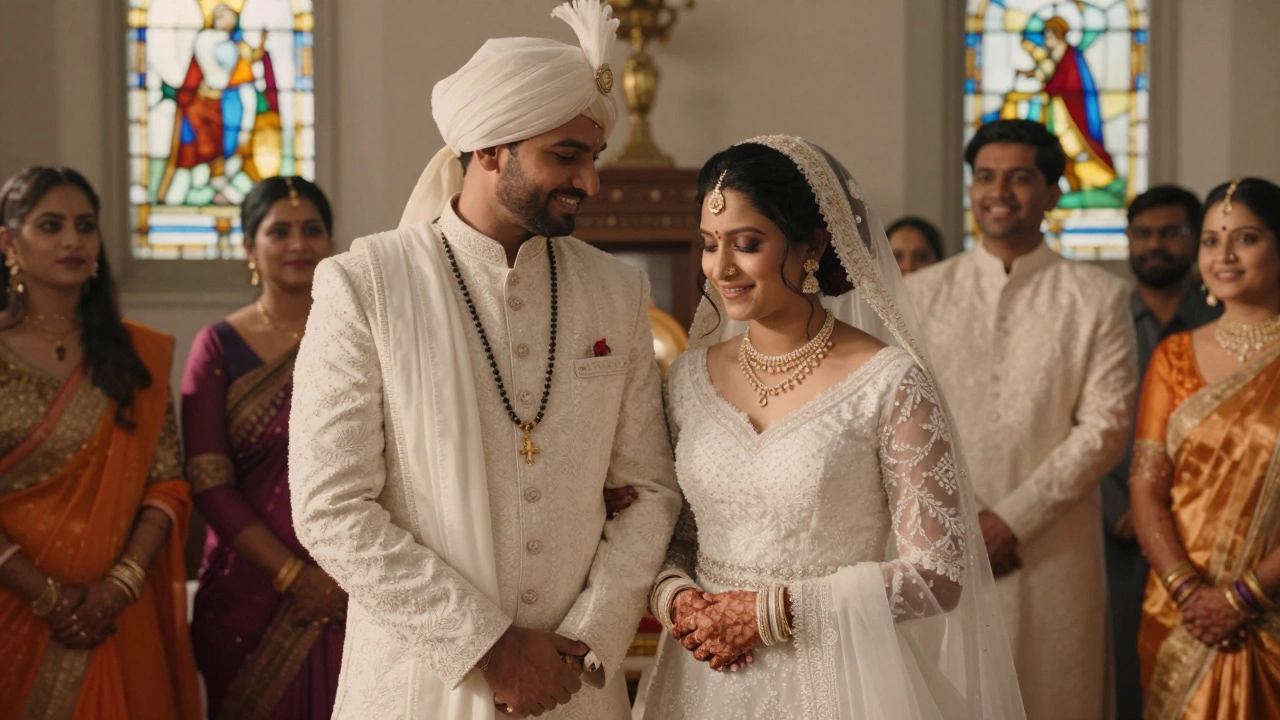
Take Meera, a Christian nurse from Goa who married a Hindu man in Mumbai. Her wedding was held in a church, with a priest conducting the ceremony. But after the vows, she changed into a red lehenga and wore a simple gold mangalsutra with two black beads - the same one her mother-in-law wore for 40 years. "I didn’t need to believe in it to respect it," she told me. "It was a way to say I’m part of this family now."
What Does the Mangalsutra Actually Represent Today?
Originally, the mangalsutra was a symbol of protection and prosperity. The black beads were believed to ward off the evil eye, and the gold represented the husband’s commitment to provide. Over time, especially in urban India, its meaning has softened. Today, for many women - Christian or Hindu - it’s less about superstition and more about continuity. It’s a visual marker of marriage, like a wedding ring in the West.
Modern mangalsutra designs have evolved too. You’ll now find minimalist chains with a single pendant, diamond-studded drops, or even platinum versions. Some Christian brides opt for designs that blend Christian symbols - like a small cross - with traditional black beads. These hybrid pieces are sold by jewelers in South Mumbai, often custom-made to suit the bride’s background.
The Rise of Hybrid Weddings
India’s urban middle class has redefined wedding rituals. Interfaith marriages are rising - up from 3% in 2001 to nearly 11% in 2025, according to the National Family Health Survey. When a Hindu groom marries a Christian bride, or vice versa, families often negotiate rituals to make everyone feel included.
That’s where the mangalsutra comes in. It’s not forced. It’s chosen. In many cases, the bride herself suggests wearing it. She might wear it during the reception, after the church ceremony, or even just for photos. Some Christian brides wear it for the entire day; others take it off after the rituals. There’s no rulebook. That’s the point.
One jewelry designer in Andheri told me he’s seen a 70% increase in orders for "Christian-friendly mangalsutras" since 2020. These are pieces that look traditional but can be worn without religious guilt. No heavy chains. No mandatory rituals. Just elegance with meaning.
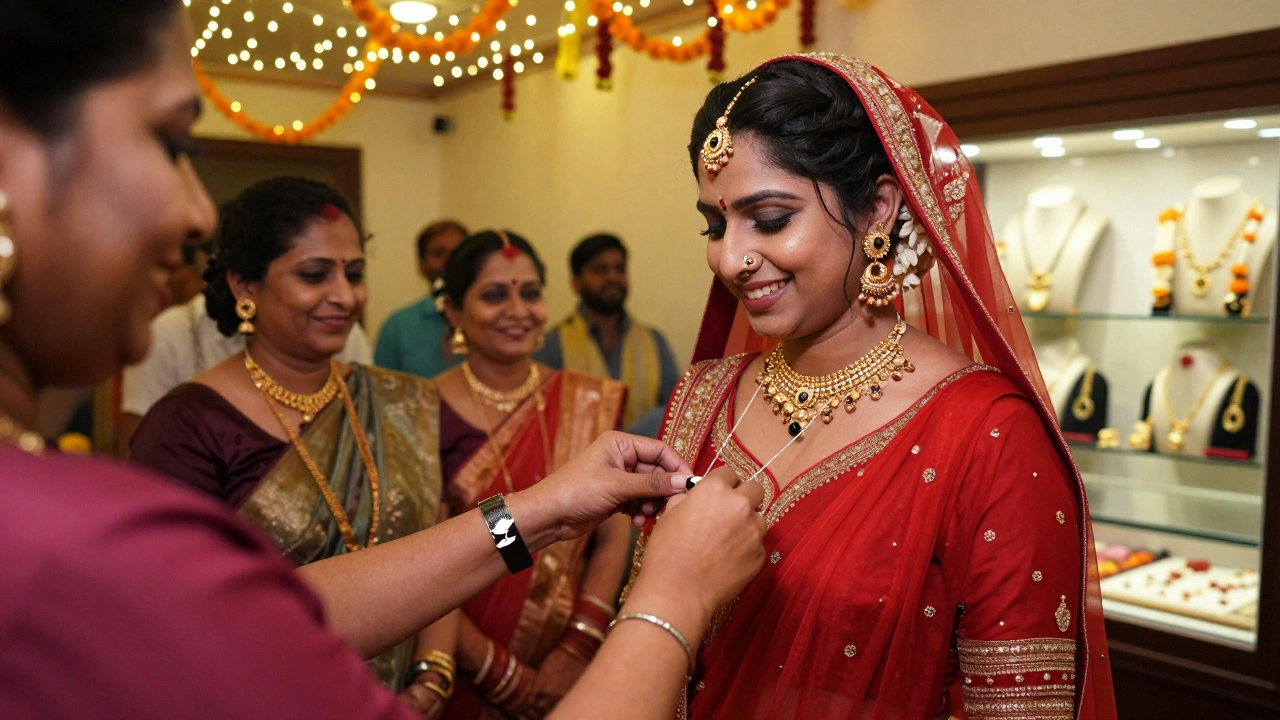
What Do Christian Leaders Say?
Most Christian denominations in India - Catholic, Protestant, Orthodox - don’t oppose the mangalsutra. They don’t endorse it either. It’s treated like any other cultural accessory, similar to wearing a sari to a Christmas party or eating diwali sweets at a colleague’s house.
Archbishop Joseph D’souza, who leads a major Christian community in Maharashtra, said in a 2024 interview: "Our faith teaches us to honor the customs of others when they don’t contradict our core beliefs. A necklace doesn’t change your soul. Love does."
Why This Matters for Indian Society
The fact that Christians wear mangalsutras today isn’t just about fashion. It’s a quiet revolution in how India sees identity. It shows that culture isn’t tied to religion - it’s tied to community, love, and shared history.
For decades, people were told that certain symbols belonged to certain faiths. But in real life, people don’t live by those boundaries. A Christian woman in Kerala might wear a thali, a Hindu girl in Delhi might wear a cross pendant, and a Sikh bride in Punjab might carry a sindoor box as a family heirloom - not because she’s Hindu, but because it’s what her grandmother did.
The mangalsutra, in this context, becomes a symbol not of division, but of unity. It’s a thread connecting families, not just brides.
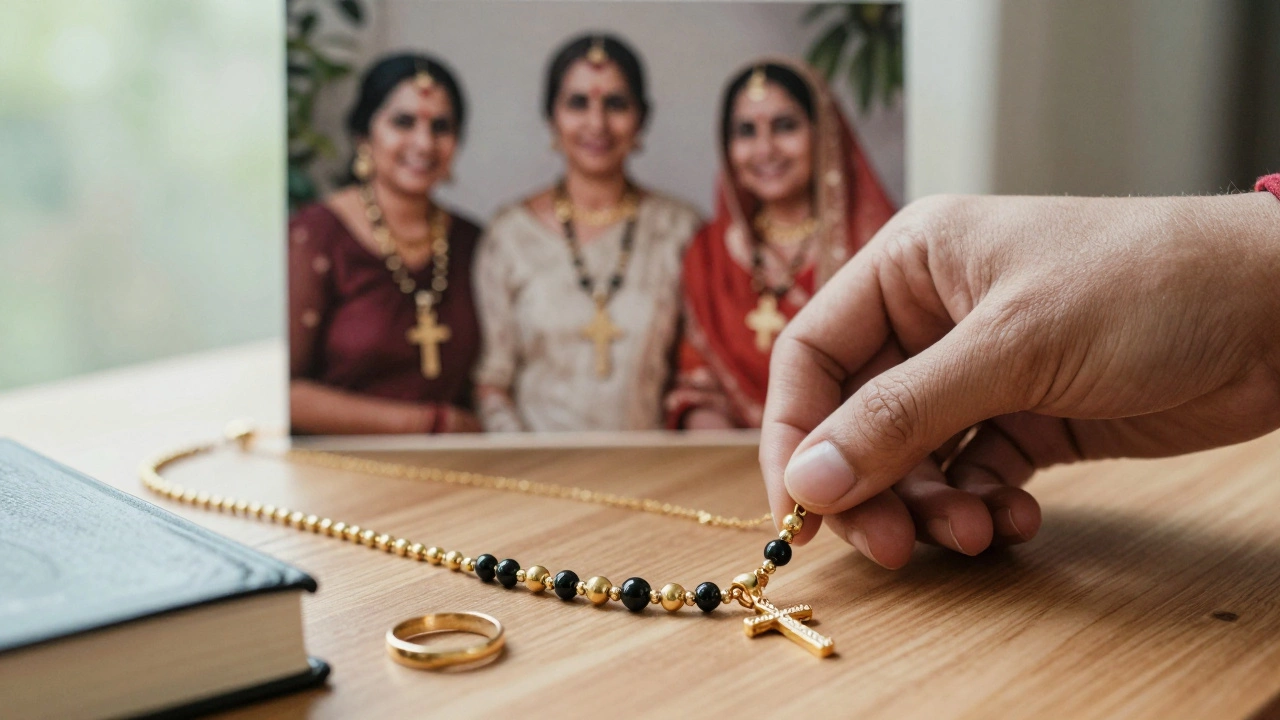
What Should You Do If You’re a Christian Bride Considering a Mangalsutra?
If you’re a Christian woman planning to wear a mangalsutra, here’s what actually matters:
- Ask yourself why. Is it because your family expects it? Or because you love the design? Both are valid.
- Choose a design that feels like you. No need to copy traditional styles. A thin gold chain with one black bead can be just as meaningful.
- Talk to your partner and his family. Make sure everyone understands it’s a cultural gesture, not a religious conversion.
- Wear it on your terms. Some brides wear it all day. Others wear it only for photos. There’s no right or wrong.
One bride I met in Pune wore a mangalsutra made from recycled gold - the same metal her mother used for her wedding ring. "It’s not Hindu. It’s mine," she said. And that’s the new truth.
Myths About Christians and Mangalsutras
Let’s clear up a few misunderstandings:
- Myth: Christians wearing mangalsutras are abandoning their faith.
Truth: They’re embracing their Indian identity. Faith and culture are separate. - Myth: The mangalsutra is only for married Hindu women.
Truth: It’s a cultural item now - worn by women of all faiths in India. - Myth: It’s disrespectful to wear it if you’re not Hindu.
Truth: Respect isn’t about religion - it’s about intention. If you wear it with love and understanding, it’s not disrespectful. It’s honoring.
Final Thought: Tradition Is Alive, Not Frozen
Traditions don’t die. They change. The mangalsutra has changed - from a ritual object to a symbol of love, family, and belonging. And in a country as diverse as India, that’s exactly what it should be.
So when you see a Christian bride wearing a mangalsutra, don’t ask if it’s right. Ask why it matters to her. Chances are, the answer will be simpler than you think: because it feels like home.
Do Christians in India have to wear a mangalsutra?
No, Christians in India are not required to wear a mangalsutra. It’s not part of Christian religious practice. Some choose to wear it as a cultural gesture, especially when marrying into a Hindu family, but it’s entirely optional.
Is wearing a mangalsutra a form of religious conversion?
No, wearing a mangalsutra is not religious conversion. It’s a cultural or familial choice. Many Christian women wear it to honor their in-laws or embrace Indian wedding traditions, without changing their faith.
Can a Christian bride wear a mangalsutra in a church wedding?
Yes, many do. The church ceremony typically focuses on vows and rings. The mangalsutra is usually worn later, during reception events or photo sessions. Some churches allow it as long as it doesn’t replace the wedding ring or interfere with the sacrament.
What’s the difference between a mangalsutra and a thali?
The mangalsutra is typically a black bead necklace with gold pendants, common in Maharashtra and North India. The thali is a pendant tied on a yellow thread, common in South India. Both symbolize marriage, but they come from different regional traditions. A Christian bride might wear either, depending on family background.
Are there Christian-themed mangalsutras available?
Yes. Many jewelers in Mumbai, Bangalore, and Hyderabad now offer hybrid designs - like a gold chain with a small cross pendant or a mangalsutra with a dove motif. These are popular among Christian brides who want to honor tradition without compromising their faith.